

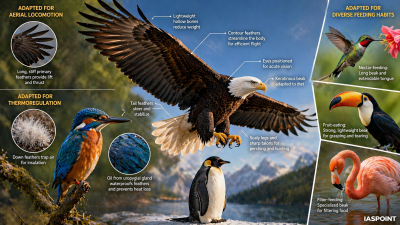
The external anatomy of birds is a testament to evolutionary engineering, specifically refined for aerial locomotion, thermoregulation, and diverse feeding habits.
Body Plan and Division
The avian body is spindle-shaped or streamlined to minimize air resistance (drag) during flight. It is divided into four distinct regions:
- Head: Small and light, containing the brain, sensory organs, and the beak.
- Neck: Long and flexible, compensating for the lack of forelimb dexterity and the rigid torso.
- Trunk: Compact and rigid to provide a stable platform for flight muscle attachment.
- Tail: Short and muscular, supporting the tail feathers used for steering and braking.
Integumentary System: Feathers and Skin
The skin of a bird is thin, dry, and devoid of sweat glands, which helps in weight reduction.
Uropygial Gland (Preen Gland)
Most birds possess a single oil gland located at the base of the tail. This gland secretes an oily fluid used by the bird to “preen” or waterproof its feathers and maintain beak health. It is notably absent in many flightless birds (Ratites).
Feathers (Plumage)
Feathers are modified reptilian scales made of beta-keratin. They serve three primary functions: flight, insulation, and signaling.
- Contour Feathers: Provide the streamlined shape of the body.
- Remiges: Large feathers on the wings used for flight.
- Rectrices: Tail feathers used for navigation.
- Down Feathers: Located close to the skin; they lack barbs and provide thermal insulation by trapping air.
The Avian Bill (Beak)
The beak is a highly specialized structure consisting of the upper and lower mandible covered by a keratinous sheath called the Rhamphotheca. Since birds lack teeth to reduce weight, the beak is the primary tool for food procurement and defense.
| Beak Type | Function | Examples |
| Hooked | Tearing flesh; typical of carnivores. | Eagles, Vultures, Owls |
| Short and Conical | Cracking seeds and grains. | Sparrows, Finches |
| Long and Tubular | Probing flowers for nectar. | Sunbirds, Hummingbirds |
| Chisel-like | Boring into wood to find insects. | Woodpeckers |
| Spatulate/Filtered | Sifting food from water or mud. | Ducks, Flamingos |
Wings and Forelimbs
The forelimbs are modified into wings. The skeletal structure of the wing is homologous to the human arm, consisting of the humerus, radius, and ulna, though the “hand” bones are fused to provide a rigid leading edge for flight.
Hindlimbs and Feet (Legs)
The hindlimbs are adapted for walking, perching, swimming, or grasping prey. The lower part of the leg and the feet are covered with scales, a trait inherited from their reptilian ancestors.
- Perching Feet: Three toes facing forward and one backward (hallux) to automatically lock onto branches (e.g., Crows, Sparrows).
- Raptorial Feet: Equipped with sharp, curved claws called talons for capturing prey (e.g., Hawks).
- Webbed Feet: Skin folds between toes to act as paddles for swimming (e.g., Ducks, Gulls).
- Syndactyl Feet: Two toes fused for part of their length (e.g., Kingfishers).
Sensory Morphology
- Eyes: Large relative to head size. Birds possess a unique vascular structure called the Pecten inside the eye, which is believed to nourish the retina and enhance visual acuity.
- Nictitating Membrane: A “third eyelid” that is transparent or translucent. It can be drawn across the eye for protection and moisture while maintaining visibility during flight.
- External Ears: Birds lack a fleshy external ear (pinna). Instead, they have ear openings covered by specialized feathers (auriculars) that protect the ear without muffling sound.
Trivia for Aspirants
- Cere: The fleshy, waxy patch at the base of the upper beak (prominent in Parrots and Pigeons) which often contains the nostrils.
- Molt: The process of shedding old feathers and growing new ones, usually occurring once or twice a year to maintain flight efficiency.
- Scale Homology: The presence of scales on the legs of birds is one of the strongest morphological evidences of the “glorified reptile” theory.