

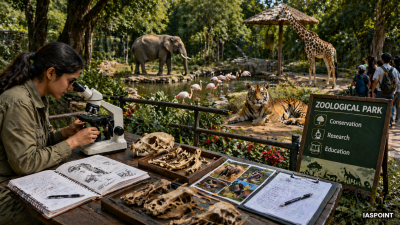
Zoological parks serve as living laboratories for taxonomists to study morphological and behavioral traits that assist in precise species classification.
Classification of Zoological Parks in India
The Central Zoo Authority (CZA), a statutory body under the Ministry of Environment, Forest and Climate Change (MoEFCC), classifies zoos based on area, number of animals, and species diversity.
| Category | Criteria (Approximate) | Purpose |
| Large Zoo | Area > 75 hectares; > 75 species | Research, breeding, and mass education. |
| Medium Zoo | Area 35–75 hectares; 50–75 species | Regional conservation focus. |
| Small Zoo | Area 10–35 hectares; 20–50 species | Local awareness and rescue. |
| Mini Zoo | Area < 10 hectares; < 20 species | Rescue centers and deer parks. |
Major Zoological Parks of National Importance
National Zoological Park (Delhi Zoo)
Established in 1959, this park is a model for scientific management. It plays a significant role in the conservation of the White Tiger, which is a genetic variation of the Bengal Tiger (Panthera tigris tigris).
- Key Species: Brow-antlered Deer (Sangai), Indian Rhinoceros, and various migratory birds.
- Taxonomic Note: It provides insights into the phenotypic variations of the Felidae family.
Arignar Anna Zoological Park (Vandalur Zoo), Tamil Nadu
Known as the largest zoological garden in India, it was the first public zoo in the country (originally established in 1855).
- Conservation Breeding: Focuses on the Lion-tailed Macaque (Macaca silenus), an endangered primate endemic to the Western Ghats.
- Significance: It maintains a comprehensive biological park layout that replicates distinct ecosystems for taxonomic study.
Padmaja Naidu Himalayan Zoological Park, West Bengal
Located in Darjeeling, this is the only specialized zoo in India for high-altitude biota.
- Conservation Success: Famous for the conservation breeding of the Red Panda (Ailurus fulgens) and the Snow Leopard (Panthera uncia).
- Taxonomic Fact: The Red Panda was recently reclassified into two distinct species: the Himalayan Red Panda and the Chinese Red Panda, based on phylogenetic research conducted in such facilities.
Mysore Zoo (Sri Chamarajendra Zoological Gardens), Karnataka
One of the oldest and most popular zoos in India, established in 1892.
- Focus: It is renowned for breeding anacondas and giraffes.
- International Linkages: Active in animal exchange programs which help in maintaining genetic diversity (Heterosis) in captive populations.
Specialized Conservation Breeding Centers (CBCs)
The CZA identifies specific zoos as “coordinating zoos” for the recovery of critically endangered species.
- Vulture Conservation Breeding Centre (VCBC), Pinjore: Dedicated to the Gyps species (White-backed, Slender-billed, and Long-billed vultures) affected by Diclofenac poisoning.
- Nandankanan Zoological Park, Odisha: The first zoo in the world to breed the White Tiger and the Melanistic Tiger. It is also a major center for Gharial (Gavialis gangeticus) conservation.
- Nehru Zoological Park, Hyderabad: The first zoo in India to have a “Lion Safari” and a dedicated nocturnal animal house.
Taxonomical Nomenclature and Conservation Status
| Common Name | Scientific Name | IUCN Status | Primary Zoo/Habitat |
| Sangai (Dancing Deer) | Rucervus eldii eldii | Endangered | National Zoo (Delhi) / Keibul Lamjao |
| Great Indian Bustard | Ardeotis nigriceps | Critically Endangered | Jodhpur Zoo (Breeding center) |
| Pygmy Hog | Porcula salvania | Endangered | Guwahati Zoo (Assam) |
| Asiatic Lion | Panthera leo leo | Endangered | Sakkarbaug Zoo (Junagadh) |
Important Statutory and Legal Frameworks
Central Zoo Authority (CZA)
- Establishment: Constituted under the Wildlife (Protection) Act, 1972 (amended in 1991).
- Functions: To specify minimum standards for housing and veterinary care, and to regulate the exchange of animals between Indian and foreign zoos.
- Objective: To complement in-situ conservation by providing “off-site” protection to endangered species.
Taxonomic Tools in Zoos
- Studbooks: These are chronological records of the history of a specific captive population. They are essential for avoiding inbreeding and maintaining the taxonomic integrity of a subspecies.
- Taxidermy: Many zoos maintain natural history museums where preserved specimens are used for morphological comparison and teaching taxonomy.
Trivia for Prelims
- First Zoo in India: The Marble Palace Zoo in Kolkata (Private) or the Madras Zoo (Public).
- World Association of Zoos and Aquariums (WAZA): The global alliance that sets the international standards for animal welfare and conservation.
- Ex-Situ vs In-Situ: While National Parks and Sanctuaries are In-Situ (natural habitat), Zoos and Botanical Gardens are Ex-Situ (outside natural habitat).
- Zoo DNA Banks: Some advanced Indian zoos are collaborating with the Laboratory for the Conservation of Endangered Species (LaCONES) in Hyderabad for DNA profiling of captive animals.