

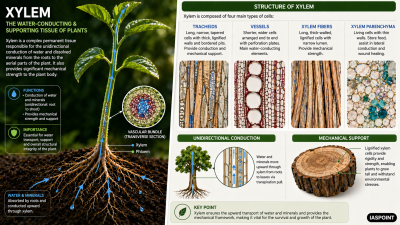
Xylem is a complex permanent tissue responsible for the unidirectional conduction of water and dissolved minerals from the roots to the aerial parts of the plant. It also provides significant mechanical strength to the plant body.
1. Composition of Xylem
Xylem is composed of four distinct types of cells. Except for Xylem Parenchyma, all other components are dead at maturity and have lignified cell walls.
- Tracheids: These are elongated, tube-like cells with tapering ends and thick, lignified walls. They are dead cells without protoplasm. Their primary function is the conduction of water and providing mechanical support. They are the chief conducting elements in non-flowering plants (Pteridophytes and Gymnosperms).
- Vessels (Tracheae): These are long, cylindrical structures formed by a row of cells placed end to end with perforated cross-walls. They are also dead and lignified. Vessels are more efficient at water conduction than tracheids and are a characteristic feature of Angiosperms (Flowering plants).
- Xylem Parenchyma: These are the only living cells in the xylem. They have thin cellulose walls and are involved in the storage of food (starch or fat) and the lateral conduction of water.
- Xylem Fibres: These are dead, highly lignified cells with obliterated central lumens. Their sole function is to provide mechanical strength to the plant.
2. Functional Dynamics
- Conduction Direction: Transport in xylem is strictly unidirectional (Ascent of Sap), moving from roots upward to the leaves.
- Driving Forces: Water movement is driven by Transpiration Pull (suction created by evaporation from leaves) and Root Pressure.
- Secondary Xylem: In woody plants, the “wood” we see is technically secondary xylem produced by the vascular cambium during secondary growth.
3. Classification Based on Development
For UPSC Prelims, understanding the arrangement of primary xylem is crucial for distinguishing between stems and roots.
- Protoxylem: The first-formed primary xylem elements (smaller vessels).
- Metaxylem: The later-formed primary xylem elements (larger vessels).
- Endarch Condition: Found in Stems, where the protoxylem lies toward the center (pith) and metaxylem lies toward the periphery.
- Exarch Condition: Found in Roots, where the protoxylem lies toward the periphery and metaxylem lies toward the center.
Comparative Summary: Xylem Components
| Component | Nature | Function |
| Tracheids | Dead | Water transport and support |
| Vessels | Dead | Efficient vertical water transport |
| Xylem Parenchyma | Living | Storage and lateral conduction |
| Xylem Fibres | Dead | Mechanical strength |
UPSC Prelims Facts and Trivia
- Vessel-less Angiosperms: While vessels are a hallmark of Angiosperms, certain primitive families (e.g., Winteraceae) lack them. Conversely, some Gymnosperms (e.g., Gnetum) possess vessels.
- Sapwood vs. Heartwood: Sapwood is the functional outer layer of secondary xylem that conducts water, while Heartwood is the central, non-functional part filled with tannins and resins, providing durability and resistance to pathogens.
- Tylose: These are balloon-like outgrowths from adjacent parenchyma cells into the lumen of xylem vessels, often blocking them in heartwood to prevent infection.
- Hadrome: A term sometimes used to describe the conducting elements of the xylem (tracheids and vessels) as a collective unit.
- Lignin Deposition: The pattern of lignin in xylem vessels can be annular (rings), spiral, scalariform (ladder-like), or pitted, which helps in identifying plant species.