

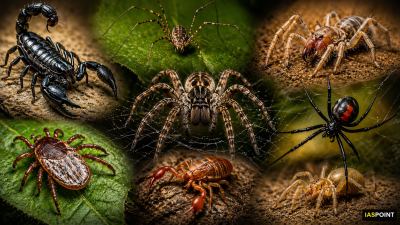
The Class Arachnida represents one of the most diverse groups within the Phylum Arthropoda.
Order Araneae: The Spiders
Spiders are the most prominent arachnids, characterized by the production of silk and the use of venom.
- Common Examples: Wolf Spiders, Jumping Spiders, Orb-weavers, and Tarantulas.
- Specialized Organs: They possess spinnerets at the end of the abdomen to extrude silk.
- Venom Apparatus: The chelicerae are modified into fangs connected to venom glands to submerge prey.
- Silk Utility: Silk is used for web construction, egg sacs, “ballooning” (aerial dispersal), and draglines.
Order Scorpiones: The Scorpions
Scorpions are among the oldest terrestrial arthropods, easily identified by their segmented anatomy.
- Telson: The terminal segment of the tail that contains the venom gland and the stinger (aculeus).
- Fluorescence: Scorpions exhibit UV fluorescence, glowing under ultraviolet light due to specific proteins in their exoskeleton (cuticle).
- Viviparity: Unlike most arachnids that lay eggs, scorpions are often viviparous, giving birth to live young that ride on the mother’s back.
- Indian Example: The Indian Red Scorpion (Hottentotta tamulus) is considered one of the most lethal species in the world.
Order Acari: Ticks and Mites
This order is of significant importance to the UPSC syllabus due to its impact on public health and agriculture.
- Morphology: Unlike spiders, the cephalothorax and abdomen are almost completely fused into a single unsegmented body.
- Ticks: These are ectoparasites that feed on the blood of mammals, birds, and reptiles.
- Mites: Often microscopic; includes dust mites, spider mites (agricultural pests), and scabies mites.
- Disease Vectors: Ticks are primary vectors for Kyasanur Forest Disease (KFD) in the Western Ghats of India and Lyme disease globally.
Order Opiliones: Harvestmen
Commonly known as “Daddy longlegs,” these are often mistaken for spiders but belong to a separate order.
- Key Difference: The cephalothorax and abdomen are broadly joined, making the body appear as a single oval shape.
- Defense Mechanism: They lack venom glands and silk glands. They rely on autotomy (shedding legs to escape predators) and scent glands that produce noxious chemicals.
Order Solifugae: Camel Spiders / Wind Scorpions
Found primarily in arid and desert regions, these arachnids are known for their speed and large mouthparts.
- Chelicerae: They possess the largest chelicerae relative to body size of any arachnid, used to crush prey.
- Locomotion: They move extremely fast and are strictly carnivorous, though they lack venom.
Comparative Summary of Major Arachnid Orders
| Feature | Araneae (Spiders) | Scorpiones (Scorpions) | Acari (Ticks/Mites) | Opiliones (Harvestmen) |
| Body Segmentation | Distinct Waist (Pedicel) | Segmented Tail | Fused Body | Fused Body |
| Venom Glands | In Chelicerae | In Telson (Tail) | Generally absent | Absent |
| Silk Production | Present (Spinnerets) | Absent | Absent | Absent |
| Pedipalps | Sensory/Mating | Pincers (Chelae) | Sensory/Feeding | Leg-like |
Ecological and Evolutionary Trivia for UPSC
- Living Fossils: Scorpions have remained morphologically similar for over 400 million years.
- Ecological Balance: Spiders are considered “Generalist Predators,” meaning they consume a wide variety of prey, preventing any single insect population from exploding.
- Indian Biodiversity: The Peacock Spider and various species of Tarantulas found in the Eastern and Western Ghats are key subjects of Indian conservation efforts.
- The “False Spider” Category: Pseudoscorpions are tiny arachnids that look like scorpions but lack a tail and stinger; they are often found in leaf litter or old books.
Biological Systems Checklist
- Excretion: Malpighian tubules (similar to insects) and Coxal glands.
- Respiration: Book lungs (Spiders/Scorpions) or Tracheae (Mites/Ticks).
- Circulation: Open system with a dorsal heart; hemolymph contains hemocyanin in some species.