

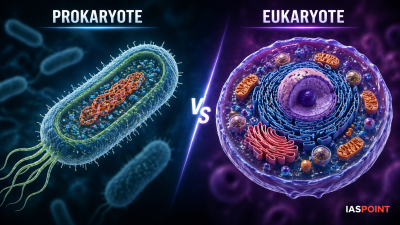
The classification of organisms into Prokaryotes and Eukaryotes is the most fundamental distinction in biological sciences.
Prokaryotic Cells (Primitive Organization)
Prokaryotes (from Greek pro meaning before and karyon meaning nucleus) are unicellular organisms characterized by the absence of a membrane-bound nucleus and organelles.
- Genetic Material: DNA is circular and lies naked in the cytoplasm in a region called the Nucleoid. They lack histones (proteins around which DNA winds).
- Organelles: They lack membrane-bound organelles like mitochondria, endoplasmic reticulum, or Golgi bodies.
- Ribosomes: They possess 70S ribosomes, which are smaller than those in eukaryotes.
- Cell Wall: Most possess a complex cell wall made of peptidoglycan.
- Examples: Bacteria, Blue-green algae (Cyanobacteria), and Mycoplasma.
Eukaryotic Cells (Advanced Organization)
Eukaryotes (from eu meaning true and karyon meaning nucleus) possess a highly organized internal structure with specialized compartments.
- Genetic Material: DNA is linear, associated with histone proteins, and enclosed within a double-membraned Nucleus.
- Organelles: Extensive compartmentalization through membrane-bound organelles (Mitochondria, Chloroplasts, Lysosomes).
- Ribosomes: They possess 80S ribosomes in the cytoplasm (though mitochondria and chloroplasts contain 70S ribosomes, supporting the Endosymbiotic Theory).
- Cytoskeleton: A complex network of microtubules and microfilaments provides structural support.
- Examples: Protists, Fungi, Plants, and Animals.
Comparative Analysis: Prokaryotes vs. Eukaryotes
| Feature | Prokaryotic Cells | Eukaryotic Cells |
| Size | Generally small (0.1–5.0 µm) | Generally large (10–100 µm) |
| Nucleus | Absent; Nucleoid region used | Present with nuclear envelope |
| DNA Shape | Circular | Linear |
| Membrane-bound Organelles | Absent | Present (Mitochondria, Golgi, etc.) |
| Ribosomes | 70S (Small) | 80S (Large) |
| Cell Division | Binary Fission (Amitosis) | Mitosis and Meiosis |
| Flagella | Simple; made of flagellin protein | Complex; 9+2 microtubule arrangement |
| Transcription/Translation | Occur simultaneously in cytoplasm | Transcription in nucleus; Translation in cytoplasm |
Specialized Features and UPSC Trivia
- Plasmids: Prokaryotes often contain small, circular, extra-chromosomal DNA called Plasmids. These carry genes for antibiotic resistance and are vital tools in Recombinant DNA Technology.
- Mesosomes: In prokaryotes, the plasma membrane infolds to form mesosomes, which help in respiration and cell wall formation (functionally analogous to mitochondria).
- Endosymbiotic Theory: This theory suggests that Eukaryotic organelles like mitochondria and chloroplasts were once free-living prokaryotes that entered into a symbiotic relationship with a host cell. Evidence includes their own circular DNA and 70S ribosomes.
- Pili and Fimbriae: Surface structures in bacteria used for attachment and conjugation (genetic exchange), distinct from flagella used for locomotion.
- Human Health: Most antibiotics (like Penicillin) target specific prokaryotic features (like peptidoglycan cell walls) so they can kill bacteria without harming human (eukaryotic) cells.
Classification of Eukaryotic Diversity
Eukaryotic cells further differentiate into Plant and Animal cells. While both are eukaryotic, plant cells possess a rigid cellulose cell wall, a large central vacuole, and chloroplasts for photosynthesis, whereas animal cells possess centrioles (for division) and lysosomes but lack cell walls.
Last Modified: April 22, 2026