

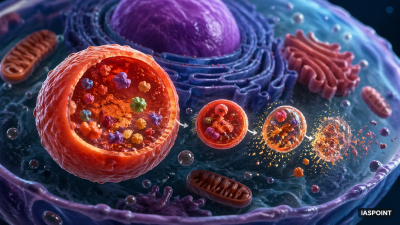
Lysosomes are membrane-bound vesicular organelles found in the cytoplasm of eukaryotic cells. Often described as the cell’s “Garbage Disposal System” or “Digestive System,” they contain a variety of enzymes capable of breaking down all types of biological polymers—proteins, nucleic acids, carbohydrates, and lipids. They were discovered by Belgian cytologist Christian de Duve in 1955.
Structural and Chemical Characteristics
Lysosomes are simple spherical sacs bounded by a single unit membrane. This membrane is crucial as it protects the rest of the cell from the powerful enzymes contained within.
- Acid Hydrolases: Lysosomes contain about 50 different digestive enzymes, collectively called acid hydrolases.
- Acidic pH: These enzymes function optimally at an acidic pH of approximately 5.0. The lysosome maintains this acidity by pumping protons (H+ ions) from the cytosol into the lumen using ATP-dependent proton pumps.
- Polymorphism: Lysosomes are polymorphic, meaning they exist in different forms (primary, secondary, residual bodies, and autophagic vacuoles) depending on their functional state.
Primary Functions of Lysosomes
1. Intracellular Digestion (Heterophagy)
Lysosomes digest materials taken in from outside the cell via endocytosis or phagocytosis. For example, white blood cells (neutrophils) use lysosomes to digest engulfed bacteria and viruses, serving as a primary line of immune defense.
2. Cellular Recycling (Autophagy)
Lysosomes break down damaged or obsolete organelles (like aged mitochondria). The breakdown products are then released back into the cytosol for reuse in metabolic processes, essentially “recycling” the cell’s own organic material.
3. Programmed Cell Death (Autolysis)
When a cell is damaged beyond repair or during specific developmental stages, lysosomes may rupture, releasing enzymes that digest the entire cell. This is why lysosomes are famously termed “Suicidal Bags” of the cell.
4. Metamorphosis
In amphibians, lysosomes play a critical role in the disappearance of the tail during the transformation of a tadpole into a frog by digesting the tail tissues.
Classification of Lysosomes
| Type | Description |
|---|---|
| Primary Lysosomes | Newly formed vesicles from the Golgi apparatus containing inactive enzymes. |
| Secondary Lysosomes | Formed by the fusion of a primary lysosome with a phagosome; site of active digestion. |
| Residual Bodies | Lysosomes containing undigested debris; these are usually eliminated by exocytosis. |
| Autophagic Vacuoles | Formed when a lysosome fuses with an intracellular organelle to digest it. |
Essential Facts for UPSC Prelims
The Endomembrane System Connection
Lysosomes are a key component of the endomembrane system. The enzymes are synthesized in the Rough ER, processed in the Golgi Apparatus, and then budded off as primary lysosomes.
Presence and Absence
- Present: Almost all animal cells. They are particularly abundant in cells related to enzymatic activity or defense, such as liver cells and leucocytes.
- Absent: Generally absent in Prokaryotes and mature mammalian RBCs.
- In Plants: While large central vacuoles in plant cells perform some lysosomal functions, “true” lysosomes are rare in plants (spherosomes often perform similar roles).
Lysosomal Storage Diseases (LSDs)
If a specific lysosomal enzyme is missing due to a genetic mutation, the substance that the enzyme was supposed to digest builds up in the cell, leading to toxicity.
- Example: Tay-Sachs Disease results from the accumulation of lipids in the brain due to a defective lysosomal enzyme.
Trivia for Competitive Exams
- Discovery: Christian de Duve won the Nobel Prize in 1974 for his discovery of lysosomes and peroxisomes.
- Stability: The lysosomal membrane contains highly glycosylated proteins that protect it from being digested by its own internal enzymes.
- Acid Phosphatase: This is the marker enzyme used to identify lysosomes in histochemical studies.