

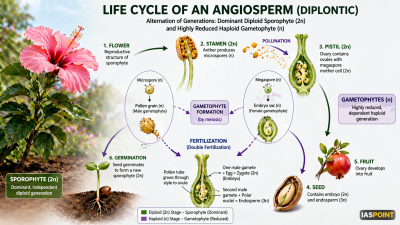
The life cycle of an angiosperm is characterized by alternation of generations between a dominant, independent diploid (2n) sporophyte and a highly reduced, dependent haploid (n) gametophyte. This cycle is categorized as diplontic, as the diploid stage is the most prominent phase of the plant’s existence.
The Sporophyte Generation (2n)
The sporophyte is the visible plant body (roots, stems, leaves, and flowers). The reproductive organs are housed within the flower.
- Stamen (Androecium): The male reproductive part, consisting of an anther and a filament.
- Pistil/Carpel (Gynoecium): The female reproductive part, consisting of the stigma, style, and ovary.
Development of Gametophytes (Gametogenesis)
Angiosperms are heterosporous, producing two types of spores that develop into distinct male and female gametophytes.
Microsporogenesis (Male)
- Inside the Anther, microspore mother cells undergo meiosis to produce four haploid microspores.
- These microspores develop into Pollen Grains (the immature male gametophyte).
- A pollen grain consists of a Generative cell (which divides to form two male gametes) and a Vegetative cell (which forms the pollen tube).
Megasporogenesis (Female)
- Inside the Ovule (located in the ovary), a megaspore mother cell undergoes meiosis to produce four haploid megaspores.
- Usually, three degenerate, and one functional megaspore develops into the Embryo Sac (the female gametophyte).
- The mature embryo sac is typically an 8-nucleate, 7-celled structure containing:
- One egg cell and two synergids (Egg apparatus).
- Three antipodal cells.
- One central cell with two polar nuclei.
Pollination and Fertilization
Pollination is the transfer of pollen grains from the anther to the stigma. Once a pollen grain lands on a compatible stigma, it germinates to form a pollen tube that grows through the style to reach the ovule.
The Process of Double Fertilization
Double fertilization is a unique diagnostic feature of all angiosperms, involving two fusion events:
- Syngamy: One male gamete fuses with the egg cell to form a diploid Zygote (2n). This zygote eventually develops into the Embryo.
- Triple Fusion: The second male gamete fuses with the two polar nuclei in the central cell to form a triploid Primary Endosperm Nucleus (PEN) (3n). This develops into the Endosperm, which provides nourishment to the embryo.
Post-Fertilization Changes
After double fertilization, a series of transformations occur to prepare the seed for dispersal.
| Structure Pre-Fertilization | Structure Post-Fertilization |
| Ovule | Seed |
| Ovary | Fruit |
| Zygote | Embryo |
| PEN (Primary Endosperm Nucleus) | Endosperm (Nutritive tissue) |
| Integuments (Ovule coats) | Seed Coat (Testa and Tegmen) |
| Ovary Wall | Pericarp (Fruit Wall) |
UPSC Prelims Technical Points
- Siphonogamy: Angiosperms exhibit siphonogamy, where male gametes are carried to the female gamete via a pollen tube, making them independent of external water for fertilization.
- Monosporic Development: The most common type of embryo sac development (Polygonum type) where only one megaspore participates in embryo sac formation.
- Filiform Apparatus: Located in the synergids, these guide the pollen tube into the embryo sac.
- Xenia and Metaxenia: Terms referring to the direct effect of pollen on the endosperm and maternal tissues (like fruit wall) respectively, often observed in maize.
- Parthenocarpy: The development of fruit without fertilization (e.g., banana), resulting in seedless fruits.
Summary of Life Cycle Stages
- Pollination: Transfer of pollen.
- Germination: Growth of the pollen tube.
- Double Fertilization: Formation of zygote and endosperm.
- Seed Development: Maturation of the embryo and storage of nutrients.
- Dormancy and Germination: Seeds remain inactive until environmental conditions (moisture, temperature) trigger the growth of a new sporophyte.