

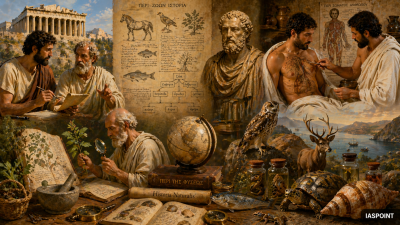
The study of biology in antiquity was not a distinct discipline but was intertwined with philosophy, medicine, and natural history. Ancient scholars sought to understand the origin of life, the classification of organisms, and human physiology through observation and deductive reasoning.
Contributions from Ancient India (Vedic and Post-Vedic Period)
Indian scholars made pioneering contributions to the fields of taxonomy, anatomy, and medicinal botany, documented primarily in Sanskrit texts.
Charaka and Sushruta: The Pillars of Ayurveda
- Charaka (c. 300 BCE): Known as the “Father of Indian Medicine.” His work, the Charaka Samhita, is a foundational text on Ayurveda. He was one of the earliest to propose the concept of metabolism, digestion, and immunity. He identified that the body contains three doshas (Vata, Pitta, and Kapha), the imbalance of which causes disease.
- Sushruta (c. 600 BCE): Often cited as the “Father of Plastic Surgery” and “Father of Indian Surgery.” The Sushruta Samhita describes over 1,100 diseases, 760 medicinal plants, and detailed surgical procedures, including rhinoplasty and cataract surgery. He provided an early classification of animals based on their habitat and birth (e.g., Jarayuya or viviparous and Andaja or oviparous).
Classification Systems in Ancient India
- Jiva and Ajiva: Early Jain philosophy classified the world into living (Jiva) and non-living (Ajiva).
- Udbhijja (Plants): Ancient texts classified plants based on their medicinal properties and growth patterns. The Rigveda mentions various herbal plants used for healing, categorizing them into Vrksha (trees), Osadhi (herbs), and Virudhs (creepers).
Contributions from Ancient Greece
The Greco-Roman tradition shifted biology from mythological explanations to empirical observation, forming the basis of Western biological nomenclature.
Aristotle: The Father of Biology
Aristotle (384–322 BCE) is credited with the first systematic study of living organisms.
- Scala Naturae: He proposed the “Great Chain of Being,” a hierarchical structure of life ranging from minerals to humans.
- Classification: He divided animals into two main groups: Enaima (with red blood/vertebrates) and Anaima (without red blood/invertebrates).
- Embryology: He observed the development of chick embryos, making him one of the first recorded embryologists.
Theophrastus: The Father of Botany
A student of Aristotle, Theophrastus (c. 371–287 BCE) authored Enquiry into Plants and On the Causes of Plants.
- Taxonomy: He classified plants into trees, shrubs, undershrubs, and herbs.
- Floral Anatomy: He was the first to distinguish between superior and inferior ovaries in flowers and understood the difference between annuals, biennials, and perennials.
Hippocrates: The Father of Medicine
Hippocrates (c. 460–370 BCE) dismissed the idea that diseases were caused by superstitions or gods. He proposed the Humoral Theory, suggesting that human health is governed by four fluids: blood, phlegm, yellow bile, and black bile.
Key Ancient Biologists and Their Primary Works
| Scholar | Region | Major Work | Key Contribution |
| Sushruta | India | Sushruta Samhita | Human anatomy, surgical techniques, and animal classification. |
| Charaka | India | Charaka Samhita | Principles of Ayurveda, digestion, and medicinal botany. |
| Aristotle | Greece | Historia Animalium | Systematic zoological classification and the Scala Naturae. |
| Theophrastus | Greece | Historia Plantarum | Botanical classification and plant reproductive systems. |
| Galen | Rome | On Anatomical Procedures | Advanced understanding of the circulatory and nervous systems via animal dissection. |
| Pliny the Elder | Rome | Naturalis Historia | An early encyclopedia covering zoology, botany, and mineralogy. |
Comparative Physiology and Anatomy in Antiquity
Ancient biologists relied heavily on “Analogy” due to social taboos regarding human dissection in certain cultures.
Observations on Human Anatomy
- Ancient Egypt: The Ebers Papyrus and Edwin Smith Papyrus (c. 1550 BCE) demonstrate an advanced understanding of the heart as the center of the blood supply and the brain’s role in controlling limbs.
- Galen’s Errors: Claudius Galen, a Roman physician, dominated medical thought for 1,500 years. However, because he dissected pigs and monkeys instead of humans, he incorrectly assumed human anatomy mirrored animal anatomy (e.g., he believed the human liver had five lobes).
Historical Trivia for UPSC Prelims
- Parasara: An ancient Indian scholar credited with Vrkshayurveda (The Science of Plant Life), which discusses plant cell structure (the Rasas) and the transport of water in plants.
- Patanjali: While primarily known for Yoga, his commentaries often touched upon the purification of the body and the physiological impact of breath control (Pranayama).
- Circulation: While William Harvey is credited with discovering blood circulation in 1628, ancient Chinese texts like the Nei Jing (c. 200 BCE) suggested that blood flows in a continuous circle controlled by the heart.
Legacy of Ancient Biology on Modern Science
The transition from ancient to modern biology was facilitated by the preservation of these texts by Islamic scholars (like Al-Jahiz, who wrote on natural selection in the 9th century) during the Middle Ages, which eventually reached Europe during the Renaissance. The foundational binomial nomenclature and physiological categories used today find their etymological roots in these ancient Greek and Sanskrit classifications.
Last Modified: April 22, 2026