

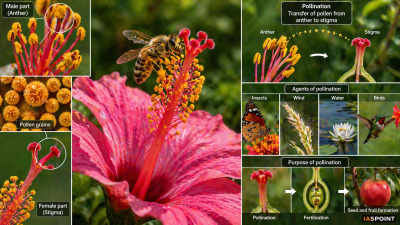
Pollination is the mechanical process of transferring pollen grains from the male reproductive organ (anther) to the receptive female reproductive organ (stigma). In Angiosperms, this is a prerequisite for fertilization, as male gametes are non-motile and require external agencies or mechanisms for transport.
Classification by Source of Pollen
Pollination is categorized based on the genetic relationship between the pollen source and the plant receiving it.
Autogamy (Self-Pollination)
Pollen is transferred from the anther to the stigma of the same flower.
- Requirements: Synchrony in pollen release and stigma receptivity; proximity of anther and stigma.
- Cleistogamy: Some plants produce “cleistogamous” flowers which never open (e.g., Viola, Oxalis, Commelina). These are invariably autogamous and produce assured seed-sets even without pollinators.
Geitonogamy
Pollen is transferred from the anther to the stigma of another flower on the same plant.
- Nature: Functionally cross-pollination (requires a pollinator) but genetically self-pollination since the pollen comes from the same parent.
Xenogamy (Cross-Pollination)
Pollen is transferred from the anther to the stigma of a flower on a different plant.
- Significance: This is the only type of pollination that brings genetically different types of pollen grains to the stigma, fostering variation.
Agents of Pollination
Plants utilize both abiotic (non-living) and biotic (living) agents. Most plants use biotic agents.
1. Abiotic Agents (Wind and Water)
- Anemophily (Wind Pollination):
- Features: Pollen grains are light, non-sticky, and produced in enormous quantities. Stamens are well-exposed, and stigmas are often large and feathery to trap air-borne pollen.
- Common Examples: Grasses (most common), Corn (the “tassels” are stigmas/styles), Palm.
- Hydrophily (Water Pollination):
- Features: Limited to about 30 genera, mostly monocots. Pollen grains are often long and ribbon-like, protected by a mucilaginous covering.
- Common Examples: Vallisneria, Hydrilla, and marine sea-grasses like Zostera.
2. Biotic Agents (Animals)
- Entomophily (Insects): Bees are the dominant biotic pollinating agents.
- Floral Adaptations: Flowers are large, colorful, fragrant, and rich in nectar. Small flowers are clustered into an inflorescence to become conspicuous.
- Ornithophily (Birds): Pollination by birds like sunbirds and hummingbirds.
- Chiropterophily (Bats): Common in plants like Anthocephalus (Kadamba) and Adansonia (Baobab).
Comparison of Pollination Syndromes
| Feature | Wind (Anemophily) | Water (Hydrophily) | Insects (Entomophily) |
| Pollen | Light, dry, non-sticky | Ribbon-like, mucilaginous | Heavy, sticky, or spiny |
| Stigma | Large, feathery | Unbranched | Sticky, often small |
| Flower | Small, no nectar/scent | Small, inconspicuous | Large, colorful, scented |
| Nectar | Absent | Absent | Present (Floral Reward) |
Outbreeding Devices (Mechanisms to Prevent Self-Pollination)
To avoid inbreeding depression, plants have evolved several mechanisms to discourage autogamy:
- Dichogamy: Pollen release and stigma receptivity occur at different times.
- Herkogamy: Physical barriers or distance between anther and stigma.
- Self-Incompatibility: A genetic mechanism that prevents self-pollen from germinating or growing a pollen tube in the same flower/plant.
- Dioecy: Production of unisexual flowers on different plants (e.g., Papaya), ensuring cross-pollination.
Floral Rewards and Pollen Robbers
- Rewards: Plants provide Nectar and Pollen grains as rewards to animal visitors. Some provide safe places to lay eggs (e.g., Amorphophallus—the tallest flower, and the Yucca-Moth relationship).
- Pollen Robbers: Many insects consume nectar or pollen without bringing about pollination; these are termed nectar/pollen robbers.
UPSC Prelims Trivia: Fact Check
- Terror of Bengal: While Eichhornia (Water Hyacinth) is aquatic, it is pollinated by insects or wind, not water, because its flowers emerge above the water level.
- Yucca and Moth: This is an example of Obligate Mutualism; neither species can complete its life cycle without the other. The moth deposits eggs in the locule of the ovary, and in turn, pollinates the plant.
- Corn Cobs: The long silky hairs seen in corn cobs are the stigmas and styles which wave in the wind to trap pollen grains.