

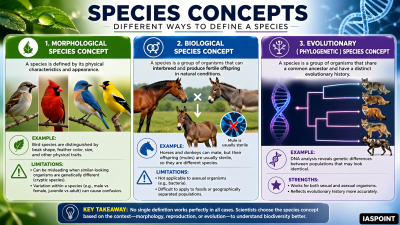
In biological classification, the Species is the fundamental and lowest taxonomic unit. While the definition seems intuitive, science utilizes several distinct concepts to define what constitutes a species, depending on whether the focus is on morphology, reproduction, or evolution.
Biological Species Concept (Mayr’s Concept)
Proposed by Ernst Mayr in 1942, this is the most widely accepted definition in modern biology.
- Definition: A species is a group of actually or potentially interbreeding natural populations that are reproductively isolated from other such groups.
- Key Criterion: The ability to produce fertile offspring.
- Limitations: It cannot be applied to asexual organisms (like bacteria), extinct species (fossils), or organisms where hybridization is common (many plants).
Alternative Species Concepts
To address the gaps in the biological concept, taxonomists use other frameworks:
- Morphological Species Concept: Defines a species based on structural and physical similarities. This is the primary method used by paleontologists for fossils.
- Phylogenetic (Evolutionary) Species Concept: Defines a species as the smallest group of individuals that share a common ancestor, forming one branch on the “tree of life.” It relies heavily on DNA sequencing.
- Ecological Species Concept: Defines a species by its ecological niche—the unique way a group of organisms interacts with the living and non-living parts of their environment.
Important Species Terminology for UPSC Prelims
Taxonomy uses specific terms to describe species based on their distribution and variation:
| Term | Definition | Example |
| Endemic Species | Found exclusively in a specific geographical area and nowhere else. | Lion-tailed Macaque (Western Ghats) |
| Keystone Species | A species that has a disproportionately large effect on its environment relative to its abundance. | Tigers, Sea Otters, Elephants |
| Indicator Species | A species whose presence, absence, or abundance reflects a specific environmental condition. | Lichens (Air pollution/SO2 levels) |
| Invasive Species | Non-native species that spread widely and cause harm to the environment or economy. | Lantana camara, Water Hyacinth |
| Sibling Species | Species that are morphologically nearly identical but are reproductively isolated. | Drosophila pseudoobscura and D. persimilis |
Variation Within a Species
Individuals within a species are not identical. These variations are categorized as follows:
1. Ecads (Ecophenes)
These are variations caused by environmental factors. If an Ecad is moved to a different environment, the variation disappears. They are genetically identical but morphologically different.
2. Ecotypes
These are populations of a species adapted to a specific environment through genetic change. Unlike Ecads, their traits are interitable and remain even if they are moved to a new environment.
3. Sub-species
A taxonomic rank below species used for populations that are geographically isolated and have developed distinct characteristics but can still interbreed if brought together.
Mechanisms of Speciation
Speciation is the evolutionary process by which populations evolve to become distinct species.
- Allopatric Speciation: Occurs when a population is divided by a geographical barrier (e.g., mountains, rivers).
- Sympatric Speciation: Occurs without geographical isolation; often due to sudden genetic changes (polyploidy) or behavioral shifts within the same habitat.
- Parapatric Speciation: Occurs when populations are separated by an extreme change in habitat rather than a physical barrier.
UPSC Prelims Fact File
- Type Specimen: The specific individual specimen to which the name of a species is scientifically attached.
- Holotype: The single specimen designated by the author as the “type” at the time of publication.
- Neotype: A specimen chosen to serve as the type when the original holotype is lost or destroyed.
- Monotypic Genus: A genus containing only one species (e.g., Ginkgo biloba).
- Taxonomic Categories: Remember that “Species” is both singular and plural. There is no such biological term as “Specie” in taxonomy.