

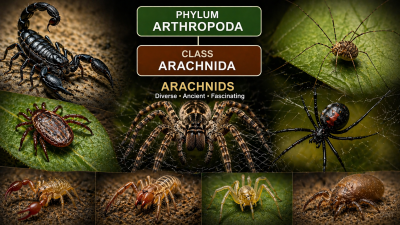
Arachnids belong to the Phylum Arthropoda and the Class Arachnida.
Key Morphological Characteristics
- Body Segments: Unlike insects (head, thorax, abdomen), arachnids have two main body parts: the Cephalothorax (prosoma) and the Abdomen (opisthosoma).
- Appendages: They possess four pairs of legs (eight total). They lack antennae and wings.
- Specialized Mouthparts: They feature Chelicerae (for biting or piercing) and Pedipalps (for sensing or grasping).
- Respiration: Accomplished via Book Lungs, Tracheae, or both.
Taxonomic Diversity
| Order | Common Name | Notable Feature |
| Araneae | Spiders | Silk production via spinnerets; venomous fangs. |
| Scorpiones | Scorpions | Segmented tail with a venomous stinger; live birth (viviparity). |
| Acari | Ticks and Mites | Smallest arachnids; many are parasitic or decomposers. |
| Opiliones | Harvestmen | “Daddy longlegs”; lack venom glands and silk glands. |
| Pseudoscorpiones | Pseudoscorpions | Small, flat, and lack the long stinging tail of true scorpions. |
Ecological Importance of Arachnids
Arachnids act as critical regulatory components in terrestrial ecosystems, maintaining the balance of food webs.
Biological Pest Control
Spiders are the primary predators of insects in most terrestrial habitats. By consuming vast quantities of aphids, caterpillars, and locusts, they prevent exponential growth in pest populations, reducing the need for chemical pesticides in agriculture.
Role in the Food Web
Arachnids serve as a vital protein source for higher trophic levels, including birds, lizards, amphibians, and small mammals. Their presence indicates a healthy, functioning ecosystem.
Soil Health and Nutrient Cycling
Mites (Order Acari) are essential for decomposition. They break down organic matter and leaf litter, facilitating the recycling of nitrogen and phosphorus back into the soil, which supports plant growth and forest regeneration.
Economic Importance of Arachnids
The economic value of arachnids extends beyond agriculture into pharmaceuticals and high-tech material science.
Applications in Medicine and Pharmacology
- Venom Research: Scorpion and spider venoms contain complex proteins and peptides. Research focuses on using these for chronic pain management, anti-arrhythmic drugs, and treating autoimmune diseases.
- Chlorotoxin: Derived from scorpion venom, it is used in “Tumor Painting” to help surgeons identify cancerous cells during surgery.
- Antivenom Production: Significant economic sectors exist for the harvesting of venom to produce life-saving antivenoms.
Biomimicry and Material Science
- Spider Silk: Known for its extraordinary tensile strength and elasticity. It is tougher than steel of the same thickness.
- Applications: Research is ongoing to replicate silk proteins for biodegradable sutures, ballistic vests, and lightweight high-performance cables.
Agricultural Impact
The presence of predatory arachnids provides “ecosystem services” valued at billions of dollars globally by naturally suppressing crop-destroying insects. Conversely, certain Acari (ticks) cause economic loss by acting as vectors for diseases like Lyme disease or Bovine Babesiosis in livestock.
Fact-Check: Arachnids vs. Insects
| Feature | Arachnids | Insects |
| Legs | 8 | 6 |
| Antennae | Absent | Present |
| Wings | Absent | Often Present |
| Eyes | Simple eyes (Ocelli) | Compound eyes |
| Metamorphosis | Incomplete (usually) | Complete or Incomplete |
Trivia for UPSC Prelims
- The Vegetarian Spider: Bagheera kiplingi is the only known spider species with a primarily herbivorous diet, feeding on Acacia trees.
- Blue Blood: Scorpions and some spiders use Hemocyanin (copper-based) instead of Hemoglobin (iron-based) to transport oxygen, giving their blood a blue tint.
- Fluorescence: Scorpions glow a vibrant cyan-green under UV light due to the presence of beta-carboline in their exoskeleton.
- Oldest Terrestrial Fossils: Arachnids were among the first animals to move from sea to land, with fossils dating back over 400 million years (Silurian period).