

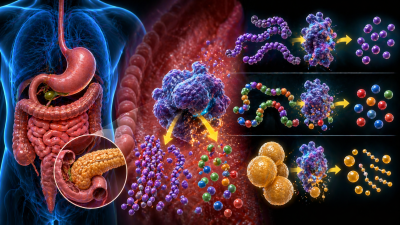
Digestive enzymes are biological catalysts (proteinaceous in nature) that break down complex macromolecules into smaller, absorbable units. In the human digestive system, these enzymes facilitate chemical digestion, transforming polymers like polysaccharides, proteins, and fats into monomers like monosaccharides, amino acids, and fatty acids.
Classification based on Substrate Specificity
The primary enzymes in the human body are categorized according to the specific nutrients they target:
- Carbohydrases: Break down carbohydrates into sugars (e.g., Salivary Amylase, Maltase).
- Proteases (Peptidases): Break down proteins into amino acids (e.g., Pepsin, Trypsin).
- Lipases: Break down lipids/fats into fatty acids and glycerol.
- Nucleases: Break down nucleic acids (DNA/RNA) into nucleotides.
Digestive Enzymes by Site of Secretion
Buccal Cavity (Mouth)
Digestion begins in the mouth where the salivary glands secrete saliva containing enzymes that initiate the breakdown of starch.
- Salivary Amylase (Ptyalin): Converts about 30% of starch into the disaccharide maltose. It functions best at an optimum pH of 6.8.
- Lysozyme: Acts as an antibacterial agent that prevents infections by attacking bacterial cell walls.
Stomach (Gastric Enzymes)
The gastric glands in the stomach lining secrete gastric juice, which is highly acidic (pH 1.8) due to Hydrochloric Acid (HCl).
- Pepsin: Secreted as inactive pepsinogen; converted to active pepsin by HCl. It digests proteins into proteoses and peptones.
- Rennin: A proteolytic enzyme found in gastric juice of infants which helps in the digestion of milk proteins (casein).
- Gastric Lipase: Secreted in minor quantities; provides minimal breakdown of lipids in the stomach.
Pancreas (Exocrine Secretions)
The pancreas is a heterocrine gland. Its exocrine portion secretes “pancreatic juice” into the duodenum via the pancreatic duct. It contains several inactive enzymes (proenzymes).
| Enzyme | Substrate | End Product |
| Trypsinogen | Proteins | Dipeptides/Peptones |
| Chymotrypsinogen | Proteins | Dipeptides |
| Procarboxypeptidases | Peptides | Amino Acids |
| Pancreatic Amylase | Polysaccharides (Starch) | Disaccharides |
| Pancreatic Lipases | Triglycerides (Fats) | Diglycerides and Monoglycerides |
| Nucleases | Nucleic Acids | Nucleotides and Nucleosides |
Small Intestine (Succus Entericus)
The intestinal juice, or succus entericus, contains enzymes that perform the final steps of digestion, converting intermediate products into simple absorbable forms.
- Dipeptidases: Convert dipeptides into amino acids.
- Maltase: Breaks down maltose into two units of glucose.
- Isomaltase: Acts on isomaltose to produce glucose.
- Lactase: Breaks down lactose (milk sugar) into glucose and galactose.
- Sucrase (Invertase): Breaks down sucrose (cane sugar) into glucose and fructose.
- Nucleosidases & Nucleotidases: Convert nucleotides into sugars and nitrogenous bases.
- Intestinal Lipase: Final breakdown of fats into fatty acids and glycerol.
Key Biochemical Activators and Hormones
The activation and regulation of these enzymes are crucial for efficient digestion and the prevention of self-digestion (autolysis).
- Enterokinase: An enzyme secreted by the intestinal mucosa that activates inactive trypsinogen into active trypsin. Trypsin then activates other pancreatic enzymes.
- Bile: While not an enzyme, bile (produced by the liver) is essential for emulsification, breaking down large fat globules into small micelles to increase the surface area for lipase action.
- Hydrochloric Acid (HCl): Provides the acidic pH necessary for pepsin and kills pathogens.
- Bicarbonate Ions: Secreted by the pancreas to neutralize stomach acid, providing the alkaline environment (pH 7.8) required for intestinal enzymes.
Comparative Summary of Macronutrient Digestion
| Nutrient | Initial Digestion Site | Primary Enzyme(s) | Final Product |
| Carbohydrates | Mouth | Salivary Amylase | Monosaccharides (Glucose) |
| Proteins | Stomach | Pepsin, Trypsin | Amino Acids |
| Fats | Duodenum | Pancreatic Lipase | Fatty acids & Glycerol |
| Nucleic Acids | Small Intestine | Nucleases | Sugars & Bases |
Important Facts for Prelims
- Zymogens: Most proteases are secreted as inactive precursors (zymogens) like pepsinogen or trypsinogen to prevent the enzyme from digesting the gland that produces it.
- Optimal pH: Salivary amylase works at pH 6.8; Pepsin at pH 1.8; Pancreatic and intestinal enzymes at pH 7.8–8.0.
- Lactose Intolerance: Caused by a deficiency of the enzyme lactase, leading to the inability to digest the sugar found in dairy products.
- Steapsin: Another name for pancreatic lipase, which is the most powerful fat-digesting enzyme in the body.
- Missing Link: The esophagus and the large intestine do not secrete any digestive enzymes; they primarily function in transport and water absorption respectively.