

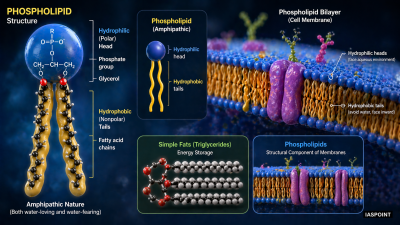
Phospholipids are a class of compound (complex) lipids that are essential components of all cellular membranes. Unlike simple fats (triglycerides) which primarily serve as energy storage, phospholipids are structural molecules. They are characterized by their amphipathic nature, meaning they possess both a hydrophilic (water-loving) head and a hydrophobic (water-fearing) tail.
Chemical Structure of Phospholipids
A typical phospholipid, such as a glycerophospholipid, consists of four main components:
- Glycerol Backbone: A three-carbon molecule that acts as the structural frame.
- Fatty Acids: Two fatty acid chains are attached to the first and second carbons of glycerol. These form the non-polar, hydrophobic “tails.” Usually, one tail is saturated and the other is unsaturated (creating a “kink”).
- Phosphate Group: Attached to the third carbon of glycerol, forming the polar “head.”
- Additional Head Group: A small polar or charged molecule (like Choline, Ethanolamine, or Serine) is often attached to the phosphate group, defining the specific type of phospholipid.
The Lipid Bilayer and Membrane Architecture
The most critical biological role of phospholipids is the formation of the cell membrane (Plasma Membrane).
- Bilayer Formation: In an aqueous environment, phospholipids spontaneously arrange themselves into a double layer. The hydrophobic tails point inward, away from water, while the hydrophilic heads face the outward aqueous environments (extra-cellular and intra-cellular fluids).
- Fluidity: The presence of unsaturated fatty acids in the tails prevents the phospholipids from packing too tightly, maintaining the “fluid” nature of the membrane.
- Selective Permeability: The hydrophobic core of the bilayer acts as a barrier to most water-soluble (polar) molecules, allowing the cell to regulate its internal environment.
Key Types of Phospholipids
| Phospholipid | Components | Significance |
| Lecithin (Phosphatidylcholine) | Glycerol + 2 Fatty Acids + Phosphate + Choline | Most abundant phospholipid in cell membranes; also acts as a lung surfactant. |
| Cephalin (Phosphatidylethanolamine) | Glycerol + 2 Fatty Acids + Phosphate + Ethanolamine | Found in nervous tissue (brain) and involved in blood clotting. |
| Phosphatidylserine | Glycerol + 2 Fatty Acids + Phosphate + Serine | Plays a key role in cell signaling and apoptosis (programmed cell death). |
| Sphingomyelin | Sphingosine (not glycerol) + Fatty Acid + Phosphate + Choline | Essential component of the myelin sheath surrounding nerve fibers. |
Physiological Functions
- Structural Integrity: They provide the basic matrix of all biological membranes, including those of organelles like mitochondria and chloroplasts.
- Lung Surfactant: Dipalmitoyl lecithin is a major component of the surfactant that coats the alveoli in the lungs, reducing surface tension and preventing lung collapse during expiration.
- Signal Transduction: Certain phospholipids (like Phosphatidylinositol) act as precursors for second messengers in hormonal signaling pathways.
- Emulsification: Phospholipids help in the emulsification of dietary fats in the digestive tract, aiding in their absorption.
UPSC Prelims Fact File
- Non-Polymeric Macromolecule: While phospholipids are found in the acid-insoluble fraction (macromolecular fraction) during chemical analysis, they are not true polymers. They appear here because they aggregate into large membranes or vesicles.
- The “Kink”: The double bond in the unsaturated fatty acid tail of a phospholipid creates a “kink” that is vital for membrane fluidity at lower temperatures.
- Liposomes: These are artificial microscopic vesicles consisting of a phospholipid bilayer. They are extensively used in modern medicine for targeted drug delivery.
- Infant Respiratory Distress Syndrome (IRDS): This condition in premature babies is often caused by a deficiency in lung surfactants (specifically lecithin), leading to difficulty in breathing.
- Asymmetry: The arrangement of phospholipids is asymmetrical; different types of phospholipids are found on the inner vs. outer leaflets of the cell membrane.