

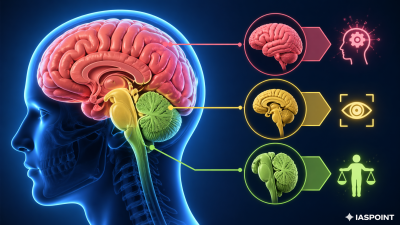
The brain is the central information processing organ of the body. It is divided into three major topographical parts: the Forebrain, Midbrain, and Hindbrain.
I. The Forebrain (Prosencephalon)
The forebrain is the most complex and largest part of the brain, housing the centers for intelligence, memory, and emotions.
Cerebrum
- Hemispheres: It consists of two cerebral hemispheres connected by a thick band of nerve fibers called the Corpus Callosum.
- Cerebral Cortex: The outer layer, known as Gray Matter, is highly convoluted with folds (Gyri) and grooves (Sulci) to increase surface area for neurons.
- Lobes and Functions:
- Frontal Lobe: Responsible for decision-making, problem-solving, and voluntary muscle movement (Motor Area).
- Parietal Lobe: Processes sensory input like touch, pressure, and pain (Somatosensory Area).
- Temporal Lobe: Primary center for auditory processing and language comprehension.
- Occipital Lobe: Dedicated exclusively to visual processing.
Diencephalon
- Thalamus: Situated at the center of the forebrain, it acts as a “Relay Station” for all sensory information (except smell) heading to the cerebrum.
- Hypothalamus: Located at the base of the thalamus.
- It controls body temperature, urge for eating and drinking (osmoregulation).
- It secretes hypothalamic hormones and controls the Pituitary Gland.
- It contains centers for emotional reactions like excitement, pleasure, and fear.
II. The Midbrain (Mesencephalon)
The midbrain is located between the thalamus/hypothalamus of the forebrain and the pons of the hindbrain.
- Cerebral Aqueduct: A narrow canal that passes through the midbrain, connecting the third and fourth ventricles of the brain.
- Corpora Quadrigemina: The dorsal portion of the midbrain consists of four rounded lobes/swellings. These are responsible for visual and auditory reflex actions (e.g., tracking a moving object with your eyes).
III. The Hindbrain (Rhombencephalon)
The hindbrain connects the higher brain centers to the spinal cord and manages autonomic survival functions.
Cerebellum (The “Little Brain”)
- It has a very convoluted surface to accommodate more neurons.
- It is the primary center for maintaining posture, equilibrium, and muscle tone.
- It coordinates precision in voluntary movements (e.g., walking in a straight line or picking up a pencil).
Pons Varolii
- Consists of fiber tracts that interconnect different regions of the brain.
- It contains the Pneumotaxic Center, which moderates the functions of the respiratory rhythm center.
Medulla Oblongata
- The hindmost part of the brain that continues as the spinal cord.
- It contains vital centers that control:
- Cardiovascular reflexes: Heartbeat and blood pressure.
- Respiratory Rhythm: Primary control of breathing.
- Gastric Secretions: Digestion and vomiting.
Brain Stem and Vital Connections
The Midbrain, Pons, and Medulla Oblongata together form the Brain Stem. The brain stem forms the critical connection between the brain and the spinal cord, ensuring the flow of messages between the brain and the rest of the body.
Comparative Summary of Brain Parts
| Region | Major Parts | Primary Function for UPSC Prelims |
| Forebrain | Cerebrum, Thalamus, Hypothalamus | Intelligence, Sensory Relay, Homeostasis, Endocrine Control. |
| Midbrain | Corpora Quadrigemina | Visual and Auditory Reflexes. |
| Hindbrain | Cerebellum, Pons, Medulla | Balance, Respiratory Control, Involuntary Vital Actions. |
Prelims-Specific Trivia
- Limbic System: Often called the “Emotional Brain,” it is formed by the inner parts of cerebral hemispheres and a group of associated deep structures like the Amygdala and Hippocampus. It regulates sexual behavior and emotional expression.
- White Matter vs. Gray Matter: In the brain, Gray matter (unmyelinated) is external, while White matter (myelinated) is internal. This is reversed in the spinal cord.
- Ventricles: These are four cavities within the brain filled with Cerebrospinal Fluid (CSF) that provide cushioning and nutrient distribution.