

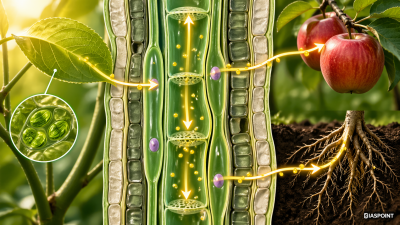
Phloem is the living complex permanent tissue responsible for Translocation—the transport of soluble organic compounds (primarily sucrose) prepared during photosynthesis from the leaves (source) to other parts of the plant like roots, fruits, and storage organs (sink). Unlike xylem, phloem transport is typically bidirectional.
1. Composition of Phloem
Phloem consists of four types of specialized cells. In contrast to xylem, most phloem components are living, with the exception of phloem fibres.
- Sieve Tubes: These are long, tube-like structures arranged longitudinally. Their end walls are perforated like a sieve, forming Sieve Plates.
- Note: Mature sieve tube elements possess a peripheral layer of cytoplasm and a large vacuole but lack a nucleus.
- Companion Cells: These are specialized parenchymatous cells closely associated with sieve tube elements.
- Function: Since sieve tubes lack a nucleus, the companion cells control their metabolic activities. They help in maintaining the pressure gradient in the sieve tubes.
- Phloem Parenchyma: These are living, elongated cells with dense cytoplasm and a nucleus.
- Function: They store food and other substances like resins, latex, and mucilage.
- Fact: Phloem parenchyma is generally absent in most monocots.
- Phloem Fibres (Bast Fibres): These are elongated, unbranched, dead sclerenchymatous cells with thick cell walls.
- Function: They provide mechanical strength to the plant.
- Commercial Use: Fibres of jute, flax, and hemp are actually phloem fibres.
2. Functional Dynamics of Phloem
- Direction of Flow: Movement in phloem is Bidirectional (or multidirectional), moving from leaves to roots for storage, or from storage organs to growing buds in spring.
- Mechanism: Translocation occurs via the Pressure Flow Hypothesis (or Mass Flow Hypothesis), where sugar is actively loaded into sieve tubes, creating an osmotic gradient that forces water into the phloem, pushing the sap toward the sink.
- Leptome: This term is specifically used to describe the conducting part of the phloem (sieve elements).
3. Classification Based on Development
Similar to xylem, phloem is categorized based on the timing of its appearance during the plant’s life cycle.
- Protophloem: The first-formed primary phloem; it consists of narrow sieve tubes.
- Metaphloem: The later-formed primary phloem; it possesses bigger sieve tubes.
- Secondary Phloem: Produced by the vascular cambium during secondary growth. It is located just outside the vascular cambium and forms part of the inner bark.
Comparative Summary: Phloem Components
| Component | Nature | Primary Function |
| Sieve Tubes | Living (Anucleated) | Main channel for sugar transport |
| Companion Cells | Living | Loading/Unloading & metabolic control |
| Phloem Parenchyma | Living | Storage and lateral transport |
| Phloem Fibres | Dead | Mechanical support (structural) |
UPSC Prelims Facts and Trivia
- The Nucleus Paradox: Sieve tubes are one of the rare examples of living cells that function without a nucleus. In the animal kingdom, mature Red Blood Cells (RBCs) share this characteristic.
- Callose Plug: During winters or injury, a carbohydrate called Callose is deposited on sieve plates to block the pores, preventing the loss of sap.
- Gymnosperm Exception: Gymnosperms (like Pines) lack sieve tubes and companion cells. Instead, they have Sieve Cells and Albuminous Cells (also called Strasburger cells).
- Girdling Experiment: If a ring of bark (which includes phloem) is removed from a tree, the roots die first because the food supply from the leaves is cut off, while water transport (xylem) remains intact.
- Aphids and Phloem: Scientists often use aphids (insects) to study phloem sap because these insects insert their stylets directly into sieve tubes to feed on the sugar-rich fluid.
Comparison Table: Xylem vs. Phloem
| Feature | Xylem | Phloem |
| Primary Function | Water and Mineral transport | Food (Sucrose) transport |
| Direction | Unidirectional (Upwards) | Bidirectional (Source to Sink) |
| Living/Dead | Mostly dead cells | Mostly living cells |
| Conducting Element | Tracheids and Vessels | Sieve Tubes |
| Supportive Element | Xylem Fibres | Phloem Fibres (Bast) |