

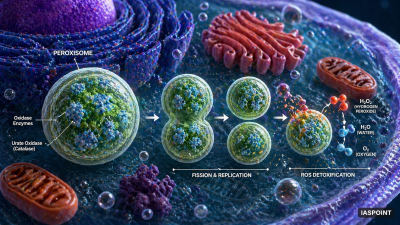
Peroxisomes are small, membrane-bound organelles found in the cytoplasm of eukaryotic cells. Unlike lysosomes, which are formed from the Golgi complex, peroxisomes are formed by the incorporation of proteins and lipids into pre-existing peroxisomes, which then split by fission. They are essential for metabolic signaling and reactive oxygen species (ROS) detoxification.
Structural Characteristics
Membrane and Core
- Single Membrane: Peroxisomes are enclosed by a single lipid bilayer, distinguishing them from double-membranous organelles like mitochondria or chloroplasts.
- Crystalline Core: In many species (though notably absent in humans), the interior contains a dark, electron-dense crystalline core of urate oxidase enzymes.
- Size and Distribution: They typically range from 0.1 to 1.0 micrometers in diameter and are ubiquitous in eukaryotic cells, though especially numerous in the liver and kidney cells of mammals.
Biochemical Functions and Mechanisms
Lipid Metabolism and Beta-Oxidation
Peroxisomes play a critical role in the breakdown of fatty acid molecules. While mitochondria also perform beta-oxidation, peroxisomes are specifically tasked with the breakdown of Very Long Chain Fatty Acids (VLCFA) (carbon chains > 22). These are broken down into shorter chains and exported to mitochondria for final energy production.
Hydrogen Peroxide (H2O2) Metabolism
The name “peroxisome” is derived from its hydrogen peroxide-generating activities.
- Oxidases: These enzymes remove hydrogen atoms from organic substrates (R), producing hydrogen peroxide as a byproduct: RH2 + O2 → R + H2O2.
- Catalase: This is the signature enzyme of the peroxisome. It neutralizes the toxic H2O2 by converting it into water and oxygen ($2H_2O_2 \rightarrow 2H_2O + O_2), or uses it to oxidize other phenols and alcohols. </li> </ul> <h5>Biosynthesis of Plasmalogens</h5> <p> Peroxisomes contain enzymes required for the synthesis of <b>plasmalogens</b>, a class of phospholipids that are primary components of the <b>myelin sheath</b> in nerve cells. Deficiencies in peroxisomal function lead to neurological “demyelination” disorders. </p> <h4>Comparative Analysis: Peroxisomes vs. Lysosomes</h4> <table> <thead> <tr> <td><strong>Feature</strong></td> <td><strong>Peroxisomes</strong></td> <td><strong>Lysosomes</strong></td> </tr> </thead> <tbody> <tr> <td><b>Origin</b></td> <td>Self-replicating (Fission)</td> <td>Budding from Golgi Apparatus</td> </tr> <tr> <td><b>Primary Enzymes</b></td> <td>Oxidases and Catalase</td> <td>Hydrolases (Digestive enzymes)</td> </tr> <tr> <td><b>Function</b></td> <td>Oxidation of lipids and detoxification</td> <td>Digestion of macromolecules and debris</td> </tr> <tr> <td><b>pH Environment</b></td> <td>Near-neutral (pH ~7.0)</td> <td>Acidic (pH ~4.5 to 5.0)</td> </tr> <tr> <td><b>Key Activity</b></td> <td>H_2O_2metabolism</td> <td>Intracellular digestion</td> </tr> </tbody> </table> <h4>Specialized Peroxisomes in Plants</h4> <h5>Glyoxysomes</h5> <p> Found in the germinating seeds of plants, these specialized peroxisomes contain the enzymes for the <b>Glyoxylate Cycle</b>. This cycle allows the plant to convert stored fats into carbohydrates (sugar), providing energy for the seedling before it can perform photosynthesis. </p> <h5>Photorespiration</h5> <p> In green leaves, peroxisomes work in tandem with chloroplasts and mitochondria to carry out <b>photorespiration</b> (theC_2$ cycle), which involves the glycolate pathway to recover carbon when oxygen levels are high.
Clinical Significance and Genetic Disorders
Peroxisomal disorders are typically categorized into two groups: those involving the biogenesis of the organelle and those involving a single enzyme deficiency.
Zellweger Spectrum Disorders (ZSD)
This is a group of rare, genetic conditions caused by mutations in the PEX genes, which are responsible for the proper assembly of peroxisomes.
- Zellweger Syndrome: The most severe form, characterized by the absence of functional peroxisomes, leading to the accumulation of VLCFAs and lack of plasmalogens, resulting in severe brain, liver, and kidney damage.
X-linked Adrenoleukodystrophy (X-ALD)
A disorder of peroxisomal fatty acid oxidation. It results in the accumulation of VLCFAs in the brain and adrenal glands, leading to the breakdown of the myelin sheath.
Facts and Trivia for UPSC Prelims
- Detoxification Center: In the human liver, peroxisomes are responsible for detoxifying about 25% of the ethanol (alcohol) consumed by oxidizing it to acetaldehyde.
- Bile Acid Synthesis: While the liver produces bile, the final steps of bile acid synthesis (specifically the oxidation of cholesterol side chains) occur within the peroxisome.
- Oxygen Sensor: Peroxisomes are considered intracellular oxygen sensors because their oxidative reactions are highly dependent on local oxygen concentration.
- Discovery: They were first identified by Christian de Duve in 1967, who also discovered lysosomes.