

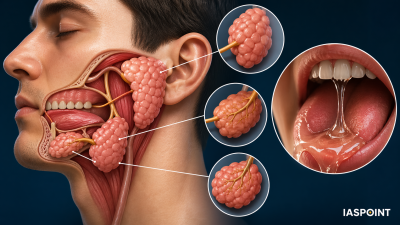
Salivary glands are exocrine glands located outside the buccal cavity that secrete saliva into the mouth through specific ducts. In humans, there are three principal pairs of salivary glands. Saliva plays a critical role in both the mechanical lubrication of food and the initial chemical digestion of carbohydrates.
Classification and Location
The three pairs of glands are positioned at different sites around the oral cavity:
- Parotid Glands: The largest of the salivary glands, located in the cheek area, just in front of and below each ear.
- Sub-mandibular (Sub-maxillary) Glands: Located at the angles of the lower jaw.
- Sub-lingual Glands: The smallest of the three, situated below the tongue.
Composition of Saliva
Saliva is a complex fluid consisting of water, electrolytes, and organic compounds. On average, a human secretes about 1.0 to 1.5 liters of saliva per day.
| Component | Function/Significance |
| Water (99.5%) | Dissolves food and allows for the sensation of taste. |
| Electrolytes | Includes Na^+, K^+, Cl^-, and HCO3^-; maintains pH. |
| Salivary Amylase (Ptyalin) | An enzyme that initiates the breakdown of starch into maltose. |
| Lysozyme | An antibacterial agent that prevents infections by killing oral bacteria. |
| Mucus | Lubricates the food bolus for easy swallowing (deglutition). |
Chemical Digestion in the Mouth
The chemical process of digestion is initiated in the oral cavity by the hydrolytic action of the carbohydrate-splitting enzyme, salivary amylase.
- Optimum pH: Salivary amylase functions most efficiently at a slightly acidic pH of 6.8.
- Starch Hydrolysis: About 30% of starch is hydrolyzed in the oral cavity into the disaccharide maltose.
- Reaction: Starch →[pH 6.8]{Salivary Amylase} Maltose
Regulation of Salivation
The secretion of saliva is a nervous reflex. It can be stimulated by:
- Conditioned Reflex: The sight or smell of food (as demonstrated in Pavlov’s experiments).
- Unconditioned Reflex: The presence of food in the oral cavity.
- Autonomic Control: The parasympathetic nervous system increases salivary secretion, while the sympathetic nervous system decreases it (leading to a dry mouth during stress).
UPSC Prelims Fact File
- Mumps: A viral infection caused by a paramyxovirus that results in the painful swelling of the parotid glands.
- Stensen’s Duct: The duct associated with the Parotid gland.
- Wharton’s Duct: The duct associated with the Sub-mandibular gland.
- Ducts of Rivinus: The small ducts associated with the Sub-lingual gland.
- Thiocyanate Ions: Present in saliva, these act as antimicrobial agents alongside lysozyme.
- Chemical Nature: Saliva is slightly acidic; however, the bicarbonate ions act as a buffer to protect tooth enamel from acid-producing bacteria.
Functional Summary
- Mastication: Saliva moistens food to help the teeth grind it into a “bolus.”
- Cleansing: The constant flow of saliva helps wash away food debris and unattached bacteria.
- Taste: Chemicals in food must be in a solution (saliva) to stimulate the taste buds on the tongue.