

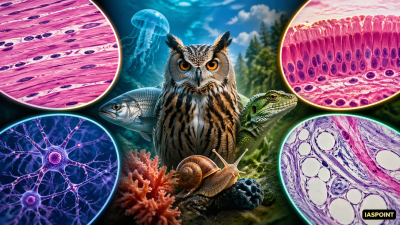
Animal tissues are broadly categorized into four primary types based on their structure, origin, and physiological functions. While the fundamental types remain consistent across the animal kingdom, their specific adaptations vary significantly between invertebrates and non-human vertebrates to suit diverse ecological niches.
1. Epithelial Tissue (Covering and Lining)
Epithelial tissue forms the continuous layer over external and internal surfaces. It is characterized by closely packed cells with minimal intercellular matrix.
- Simple Epithelium: Composed of a single layer of cells. Found in areas of absorption and filtration.
- Squamous: Flat cells; found in the lining of fish gills and coelomic cavities.
- Cuboidal: Cube-like cells; present in the nephrons of amphibians and secretory glands of insects.
- Columnar: Tall, pillar-like cells; lining the intestine of reptiles and birds for nutrient absorption.
- Compound (Stratified) Epithelium: Multiple layers of cells. Its primary function is protection against mechanical or chemical stress.
- Keratinized: Found in the scales of reptiles and feathers of birds to prevent water loss.
- Non-keratinized: Found in the moist oral cavities of amphibians.
2. Connective Tissue (Support and Binding)
This is the most diverse and abundant tissue type, derived from the embryonic mesoderm. It supports, binds, and protects other tissues and organs.
| Category | Type | Characteristics / Animal Examples |
| Loose Connective | Areolar & Adipose | Found under the skin of mammals; Blubber in whales is specialized adipose tissue for insulation. |
| Dense Connective | Tendons & Ligaments | Tendons join skeletal muscle to bone; Ligaments join bone to bone. Vital for flight in birds. |
| Specialized (Skeletal) | Cartilage & Bone | Cartilage forms the entire skeleton of Chondrichthyes (Sharks). Bone provides the framework for Teleosts (Bony fish) and Tetrapods. |
| Specialized (Fluid) | Blood & Lymph | Haemolymph in insects (open circulatory system); Nucleated RBCs are found in all non-mammalian vertebrates (Fish, Amphibians, Reptiles, Birds). |
3. Muscular Tissue (Movement and Locomotion)
Muscular tissues are composed of elongated cells called muscle fibers which contain contractile proteins (actin and myosin).
- Skeletal (Striated) Muscle: Voluntary muscles attached to the skeleton. In insects, these are exceptionally high-performance tissues allowing for rapid wing beats (up to 1000 times per second).
- Smooth (Non-striated) Muscle: Involuntary muscles found in the walls of visceral organs. They facilitate the movement of food in the digestive tract and regulate blood flow in vessels.
- Cardiac Muscle: Specialized involuntary striated muscle found exclusively in the heart. In ectothermic animals (like reptiles), the cardiac tissue is adapted to function across a wider range of temperatures than in endotherms.
4. Nervous Tissue (Control and Coordination)
Nervous tissue is specialized for the conduction of electrochemical impulses, allowing animals to respond to internal and external stimuli.
- Neurons: The functional units. In invertebrates like the Squid, “Giant Axons” evolved to facilitate rapid escape responses.
- Neuroglia: Supporting cells that protect and nourish neurons.
- Organization Levels:
- Nerve Net: Primitive, non-polarized network in Cnidarians (Jellyfish).
- Nerve Ring and Radial Nerves: Found in Echinoderms (Starfish).
- Ventral Nerve Cord: Characteristic of Annelids and Arthropods.
- Dorsal Hollow Nerve Cord: The defining feature of Chordates.
Comparative Summary: Invertebrates vs. Vertebrates
| Feature | Invertebrate Tissues | Vertebrate Tissues |
| Circulatory Tissue | Often Haemolymph (copper-based in many). | Hemoglobin-based blood (iron-based). |
| Supportive Tissue | Chitinous Exoskeleton (secreted). | Living Endoskeleton (Bone/Cartilage). |
| Nervous System | Ventral (belly side) position. | Dorsal (back side) position. |
| Respiratory Tissue | Tracheal systems or book lungs in many. | Gills or highly vascularized lungs. |
Key Facts for UPSC Prelims
- Nucleated RBCs: Unlike humans, all non-mammalian vertebrates (birds, reptiles, amphibians, and fish) possess red blood cells that retain their nuclei.
- The Hydra Exception: Hydra lacks specialized muscular and nervous tissues in the complex sense; it uses Epithelio-muscular cells which serve a dual purpose.
- Chitin: The “shell” of a crab or beetle is not a tissue but an extracellular secretion of the underlying epithelial tissue (hypodermis).
- Mesoglea: In diploblastic animals (Cnidaria), a non-cellular jelly-like layer called mesoglea exists between the ectoderm and endoderm instead of a true mesodermal tissue layer.