

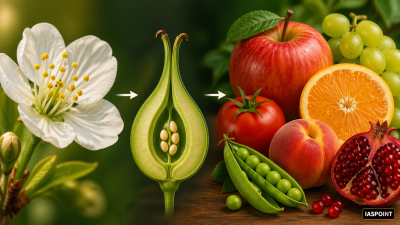
In botanical terms, a fruit is a matured or ripened ovary of a flower, usually containing seeds. Fruits are categorized based on their origin (True vs. False) and the number of ovaries involved in their formation.
Classification by Development
True Fruits (Eucarp)
Fruits that develop solely from the mature ovary of a single flower after fertilization.
- Examples: Mango, Grapes, Tomato.
False Fruits (Pseudocarp)
Fruits that develop from the ovary along with other floral parts like the thalamus or receptacle.
- Examples: Apple, Pear, Strawberry, Cashew nut.
Parthenocarpic Fruits
Fruits that develop without fertilization. These are naturally seedless.
- Examples: Banana, Grapes (certain varieties), Pineapple.
Major Fruits and Their Botanical Features
Mangifera indica (Mango)
Known as the “National Fruit of India” and the “King of Fruits.”
- Family: Anacardiaceae.
- Fruit Type: Drupe (Fleshy fruit with a hard, stony endocarp).
- Edible Part: Mesocarp.
- Trivia: India is the world’s largest producer. Common varieties include Alphonso, Dasheri, and Langra.
Musa paradisiaca (Banana)
- Family: Musaceae.
- Fruit Type: Berry (Fleshy fruit with many seeds, though commercial varieties are seedless due to triploidy).
- Edible Part: Mesocarp and Endocarp.
- Botanical Fact: The banana “tree” is technically a giant herb; the “trunk” is a pseudostem formed by tightly packed leaf bases.
Citrus Species (Citrus Fruits)
Includes Orange (C. reticulata), Lemon (C. limon), and Lime (C. aurantifolia).
- Family: Rutaceae.
- Fruit Type: Hesperidium (A modified berry with a leathery rind containing oil glands).
- Edible Part: Unicellular juicy placental hairs (juice sacs).
Malus domestica (Apple)
- Family: Rosaceae.
- Fruit Type: Pome (A simple, fleshy false fruit).
- Edible Part: Fleshy Thalamus.
- Trivia: Rich in Malic acid and pectin.
Table: Edible Parts of Common Fruits
| Fruit Name | Botanical Name | Fruit Type | Edible Part |
| Guava | Psidium guajava | Berry | Thalamus and Pericarp |
| Coconut | Cocos nucifera | Fibrous Drupe | Liquid/Solid Endosperm |
| Pomegranate | Punica granatum | Balausta | Succulent Seed Coat (Testa) |
| Papaya | Carica papaya | Berry | Mesocarp |
| Pineapple | Ananas comosus | Sorosis | Bracts, Perianth, and Axis |
| Jackfruit | Artocarpus heterophyllus | Sorosis | Perianth and Seeds |
| Litchi | Litchi chinensis | Nut | Fleshy Aril |
Categorization by Morphology
Simple Fruits
Derived from a single ovary of a single flower.
- Fleshy: Drupe (Mango), Berry (Tomato, Banana), Pome (Apple), Hesperidium (Orange).
- Dry: Legume (Pea), Nut (Cashew), Caryopsis (Wheat/Rice).
Aggregate Fruits (Etaerio)
Derived from a single flower having a group of several free ovaries (apocarpous gynoecium).
- Examples: Strawberry (Etaerio of achenes), Custard Apple (Etaerio of berries), Raspberry.
Composite / Multiple Fruits
Derived from a whole inflorescence (a group of flowers).
- Sorosis: Developed from a spike or spadix (Pineapple, Jackfruit, Mulberry).
- Syconus: Developed from a hypanthodium inflorescence (Fig, Banyan).
Economic Botany and UPSC Trivia
- The Coconut “Water”: It is botanically defined as free-nuclear endosperm. The white kernel is the cellular endosperm.
- Aril: The litchi is unique because the edible part is the Aril, an accessory covering of the seed.
- Bromelain: An enzyme found in Pineapples used for meat tenderization and medicinal purposes.
- Ethylene: The natural gaseous plant hormone responsible for the ripening of fruits. In commercial settings, Calcium Carbide is sometimes illegally used, which releases Acetylene gas to mimic ripening.
- Climacteric vs. Non-Climacteric: * Climacteric: Fruits that continue to ripen after being picked (Mango, Banana, Papaya).
- Non-Climacteric: Fruits that do not ripen once harvested (Grapes, Citrus, Pineapple).