

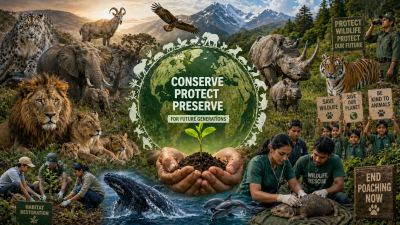
The conservation of mammals is a critical pillar of biodiversity management, aimed at preventing extinction and maintaining ecological balance.
Threats to Mammalian Biodiversity
- Habitat Fragmentation: The breaking of large habitats into smaller, isolated patches, often due to infrastructure like highways and dams.
- Poaching and Illegal Wildlife Trade: Driven by demand for skins (Leopards), ivory (Elephants), and traditional medicines (Pangolins, Rhino horns).
- Climate Change: Shifting ranges for high-altitude mammals like the Snow Leopard and loss of sea ice for Polar Bears.
- Invasive Species: Competition from non-native species can lead to the decline of endemic mammalian populations.
Legal and Institutional Frameworks in India
Wildlife (Protection) Act (WPA), 1972
- Schedule I and II: Provides absolute protection to mammals like the Tiger, Lion, Elephant, and Gangetic Dolphin. Offenses against these carry the highest penalties.
- Protected Areas: The Act provides for the notification of National Parks and Wildlife Sanctuaries.
National Board for Wildlife (NBWL)
- Chaired by the Prime Minister, it is the apex body for all wildlife-related matters and approves projects in and around protected areas.
International Conventions and Treaties
| Convention | Full Form | Role in Mammalian Conservation |
| CITES | Convention on International Trade in Endangered Species | Regulates or bans international trade in specimens of wild mammals (e.g., ivory trade ban). |
| IUCN | International Union for Conservation of Nature | Maintains the Red List, categorizing mammals from “Least Concern” to “Extinct.” |
| CMS | Convention on Migratory Species | Also known as the Bonn Convention, it protects migratory mammals like whales and bats. |
| “CA | TS” | Conservation Assured | Tiger Standards |
Major Species-Specific Conservation Projects in India
Project Tiger (1973)
- Objective: To maintain a viable population of Bengal tigers in their natural habitats.
- Management: Overseen by the National Tiger Conservation Authority (NTCA). Uses the M-STrIPES (Monitoring System for Tigers – Intensive Protection and Ecological Status) software for patrolling and surveillance.
Project Elephant (1992)
- Objective: Protection of elephants, their habitats, and corridors.
- Elephant Corridors: Narrow strips of land that allow elephants to move between larger habitat patches.
- Monitoring of Illegal Killing of Elephants (MIKE): An international program under CITES implemented in India.
Project Lion and Project Snow Leopard
- Project Lion: Focuses on the Asiatic Lion in the Gir landscape and its potential relocation to Kuno National Park (now famous for Cheetah reintroduction).
- Project Snow Leopard: Focuses on the high-altitude Himalayan ecosystem (States: J&K, Ladakh, HP, Uttarakhand, Sikkim, Arunachal Pradesh).
Conservation Status of Key Indian Mammals
- Critically Endangered: Pygmy Hog, Malabar Civet, Namdapha Flying Squirrel.
- Endangered: Lion-tailed Macaque, Sangai (Brow-antlered Deer), Ganges River Dolphin.
- Vulnerable: One-horned Rhinoceros, Nilgiri Tahr (recently upgraded to state-level protection in Tamil Nadu).
Modern Management Techniques
Ex-Situ vs. In-Situ Conservation
- In-Situ: Conservation within the natural habitat (National Parks, Biosphere Reserves).
- Ex-Situ: Conservation outside natural habitats (Zoos, Seed Banks, Captive Breeding centers like the Pygmy Hog Conservation Programme in Assam).
Technology in Management
- Radio Telemetry: Attaching collars to mammals (e.g., Cheetahs in Kuno) to track movement and health.
- Camera Trapping: Used for population estimation, particularly for elusive cats like Tigers and Leopards.
- Genetic Mapping: Identifying individual animals through DNA analysis of scat or hair samples.
Facts and Trivia for Prelims
- Umbrella Species: Mammals like the Tiger, where protecting them automatically protects many other species in the same habitat.
- Flagship Species: A species chosen to represent a cause or ecosystem (e.g., the Giant Panda for WWF).
- Eco-Sensitive Zones (ESZ): Areas within 10 km around Protected Areas acted as “shock absorbers” or transition zones.
- Integrated Development of Wildlife Habitats (IDWH): A centrally sponsored scheme that provides financial assistance to states for wildlife conservation.