

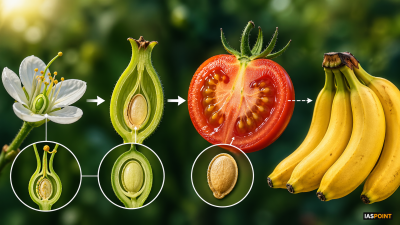
In angiosperms, a fruit is technically defined as a ripened ovary developed after fertilization. The transformation of an ovule into a seed and the ovary into a fruit is a simultaneous process. If a fruit develops without fertilization, it is termed a parthenocarpic fruit (e.g., Banana).
Structure of a Fruit
A typical fruit consists of a wall called the pericarp and the seeds. The pericarp can be dry or fleshy. When fleshy, it is further divided into three layers:
- Epicarp: The outermost skin or rind.
- Mesocarp: The middle, often edible and fleshy layer.
- Endocarp: The innermost layer, which can be membranous (Orange) or stony (Mango).
Classification of Fruits
Fruits are classified based on the number of ovaries and flowers involved in their formation.
1. Simple Fruits
Developed from a single ovary of a single flower (monocarpellary or multicarpellary syncarpous).
- Drupe: Known as “stony fruits” because of the hard endocarp. Examples: Mango (edible mesocarp), Coconut (fibrous mesocarp).
- Berry: Fleshy fruits with many seeds. Examples: Tomato, Brinjal, Guava.
- Pepo: A modified berry with a hard rind. Example: Cucumber, Watermelon.
- Hesperidium: A berry with a leathery rind and juicy unicellular hairs. Example: Lemon, Orange.
2. Aggregate Fruits (Etaerio)
Developed from a multicarpellary, apocarpous (free carpels) gynoecium of a single flower. Each free carpel forms a fruitlet.
- Etaerio of Berries: Example: Custard Apple (Sharifa).
- Etaerio of Drupes: Example: Raspberry.
3. Composite (Multiple) Fruits
Developed from an entire inflorescence rather than a single flower.
- Sorosis: Developed from a spike, spadix, or catkin. Examples: Pineapple, Jackfruit, Mulberry.
- Syconus: Developed from a hypanthodium inflorescence. Example: Fig (Ficus).
True Fruits vs. False Fruits
UPSC often tests the distinction between fruits derived solely from the ovary and those involving other floral parts.
| Type | Development Source | Examples |
| True Fruit (Eucarp) | Developed only from the ovary. | Mango, Pea, Maize |
| False Fruit (Pseudocarp) | Developed from the ovary plus other floral parts (like thalamus). | Apple, Pear, Strawberry, Cashew |
Classification Based on Dehiscence (Dry Fruits)
Dry fruits have a thin, non-fleshy pericarp and are classified by how they release seeds.
- Dehiscent: Burst automatically to discharge seeds.
- Legume/Pod: Opens along both sutures. Example: Peas, Beans.
- Capsule: Opens through pores or slits. Example: Cotton, Lady’s Finger.
- Indehiscent: Do not burst; seeds are liberated by the decay of the pericarp.
- Caryopsis: Pericarp is fused with the seed coat. Example: Wheat, Rice, Maize.
- Cypsela: Developed from an inferior ovary with a pappus (hair-like structures). Example: Sunflower.
- Nut: Hard, woody pericarp. Example: Cashew nut, Walnut.
Biological Functions of Fruits
- Protection: The primary role is to protect the developing seeds from animals, desiccation, and pathogens.
- Dispersal: Fruits are specialized for seed dispersal to prevent overcrowding and ensure species distribution.
- Zoochory: Dispersal by animals (fleshy fruits or those with hooks like Xanthium).
- Anemochory: Dispersal by wind (winged fruits like Maple or hairy fruits like Sunflower).
- Hydrochory: Dispersal by water (fibrous husks like Coconut).
- Nutrition for Embryo: In some cases, the decaying fruit provides initial organic matter for the germinating seedling.
UPSC Prelims Trivia: Fact File
- Edible Part of Mango: The Mesocarp.
- Edible Part of Coconut: The Endosperm (both liquid and solid), not the pericarp.
- Edible Part of Apple: The fleshy Thalamus.
- Caspian/Lomentum: A dry fruit that breaks into single-seeded segments (e.g., Tamarind, Groundnut).
- Parthenocarpy: Induced by plant hormones like Auxins and Gibberellins to produce seedless varieties (e.g., seedless Grapes).