

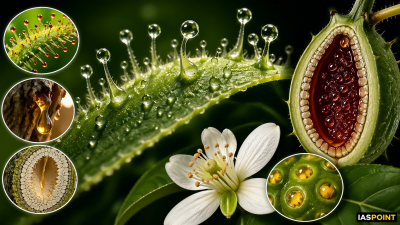
Secretory tissues are specialized plant tissues responsible for the production, storage, and release of various metabolic by-products. Unlike permanent tissues that provide structure or transport, these tissues are chemically oriented. They are vital for the plant’s defense, attraction of pollinators, and metabolic regulation.
1. Classification of Secretory Tissues
Secretory tissues are broadly divided into two categories based on where the secretion is discharged: External and Internal.
A. External Secretory Tissues
These are located on the surface of the plant body (epidermis) and release substances to the outside.
- Glandular Trichomes: Epidermal hairs that secrete essential oils, resins, or mucilage (e.g., in Mint or Lavender).
- Nectaries: Specialized glands found in flowers or on leaves that secrete Nectar (a sugar-rich fluid) to attract pollinators like bees and butterflies.
- Hydathodes (Water Stomata): Located at the tips or margins of leaves in many herbaceous plants. They are responsible for Guttation—the loss of water in liquid form under conditions of high humidity and low transpiration.
- Digestive Glands: Found in insectivorous plants (e.g., Pitcher plant, Venus Flytrap). They secrete proteolytic enzymes to digest captured insects for nitrogen.
B. Internal Secretory Tissues
These tissues are embedded within the plant body and store secretions in specialized cavities or cells.
- Secretory Cells (Idioblasts): Isolated cells containing oils, tannins, or crystals (e.g., oil cells in Cinnamon).
- Secretory Cavities/Ducts: Formed by the breakdown of cells (Lysigenous) or separation of cells (Schizogenous).
- Resin Ducts: Common in Conifers (Gymnosperms) like Pine.
- Oil Glands: Found in the rind of citrus fruits (Lemon, Orange).
- Laticiferous Tissues: Specialized tissues that secrete and store Latex (a milky or yellowish fluid).
2. Laticiferous Tissues: Deep Dive
Laticifers are highly specialized and are of significant commercial and biological importance.
| Type | Characteristics | Examples |
| Latex Cells (Non-articulated) | Single cells that grow into long, branched structures; do not fuse with other cells. | Euphorbia, Calotropis, Ficus (Banyan). |
| Latex Vessels (Articulated) | Formed by the longitudinal fusion of many cells whose end walls dissolve. | Hevea brasiliensis (Rubber tree), Papaver somniferum (Opium poppy). |
- Functions of Latex: It acts as a defense mechanism against herbivores (contains toxins), seals wounds, and stores metabolic waste or food.
3. Summary of Plant Secretions and Their Uses
| Secretion | Tissue Source | Application/Importance |
| Resins | Resin Ducts | Varnishes, turpentine, and plant defense. |
| Latex | Laticifers | Natural rubber, medicinal alkaloids (Morphine). |
| Nectar | Nectaries | Pollination and honey production. |
| Enzymes | Digestive Glands | Nitrogen acquisition in insectivorous plants. |
| Essential Oils | Glandular Trichomes | Perfumery, aromatherapy, and flavoring. |
UPSC Prelims Facts and Trivia
- Guttation vs. Transpiration: Guttation occurs through Hydathodes at night or early morning as liquid drops; Transpiration occurs through Stomata during the day as water vapor.
- Economic Botany: The latex of Hevea brasiliensis is the primary source of commercial natural rubber, while the latex of the Opium poppy contains alkaloids like morphine and codeine.
- Lysigenous Cavities: The large “oil pockets” visible on an orange peel are created when a group of secretory cells dissolve their own walls to release oil into a common cavity.
- Alkaloids: Many special tissues store alkaloids, which are nitrogenous organic compounds that serve as a defense against herbivory but are used by humans as medicines or stimulants (e.g., Quinine, Nicotine).
- Cystoliths: Specialized parenchyma cells (idioblasts) sometimes contain large crystals of calcium carbonate, known as cystoliths, often found in the leaves of the Ficus family.