

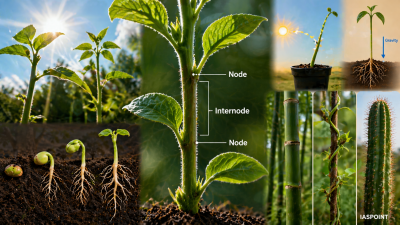
The stem is the ascending part of the plant axis that develops from the plumule of the embryo during seed germination. It is characterized by the presence of nodes (points where leaves are born) and internodes (segments between two nodes). Unlike roots, stems are generally positively phototropic (grow toward light) and negatively geotropic.
Structural Characteristics of the Stem
A stem possesses several distinct morphological features that differentiate it from other plant organs.
- Nodes and Internodes: The primary identifying feature of a stem.
- Buds: Stems bear buds, which may be terminal (at the apex for longitudinal growth) or axillary (in the axils of leaves for lateral branching).
- Trichomes: Multicellular epidermal hairs that help in reducing water loss through transpiration.
- Chlorophyll: Young stems are often green and capable of photosynthesis.
Primary Functions of the Stem
The stem acts as the central structural and transport hub of the plant.
- Support and Orientation: It bears leaves, flowers, and fruits, spreading them out to maximize sunlight exposure and facilitate pollination.
- Conduction: It facilitates the transport of water and minerals from the roots to the leaves and the translocation of photosynthates (food) from leaves to other plant parts via the Xylem and Phloem.
- Storage and Propagation: Many stems serve as reservoirs for food and water or act as units for vegetative reproduction.
Classification of Stems based on Habitat
Stems are categorized based on their growth environment and structural integrity.
| Stem Category | Description | Examples |
| Erect Stems | Strong enough to stand vertically without support. | Mango, Banyan, Wheat |
| Weak Stems | Cannot stand upright; they either trail on the ground or climb. | Mint, Pumpkin, Pea |
| Underground Stems | Grow below the soil surface; often mistaken for roots. | Potato, Ginger, Onion |
Specialized Stem Types (Weak Stems)
Weak stems are further divided based on their growth habit:
- Trailers: Spread on the ground without rooting at the nodes (e.g., Boerhavia).
- Creepers: Grow prostrate on the ground and produce roots at the nodes (e.g., Strawberry, Grasses).
- Climbers: Use specialized structures like tendrils or hooks to ascend a support (e.g., Money plant, Grapes).
- Twiners: The stem itself coils around a support without specialized organs (e.g., Cuscuta, Beans).
Detailed Internal Organization (UPSC Focus)
While morphology deals with external form, Prelims questions often touch upon the basic anatomical differences between Monocot and Dicot stems.
- Dicot Stem: Possesses a ring-like arrangement of vascular bundles and a distinct pith. It undergoes secondary growth (increase in girth) due to the presence of Cambium.
- Monocot Stem: Vascular bundles are scattered throughout the ground tissue and are “closed” (no cambium), meaning they generally do not undergo secondary growth.
UPSC Prelims Trivia: Stem Biology
- Caudex: An unbranched, erect, cylindrical stout stem marked with scars of fallen leaves (e.g., Palm trees).
- Culm: Stems with very distinct nodes and hollow internodes, typical of the Gramineae family (e.g., Bamboo).
- Excurrent Growth: The main stem continues to grow, giving the tree a cone shape (e.g., Pine, Casuarina).
- Decurrent (Deliquescent) Growth: The main stem disappears after some distance due to repeated branching, giving a rounded appearance (e.g., Banyan, Neem).
- Lenticels: Small pores on the bark of woody stems that allow for gas exchange, similar to stomata in leaves.