

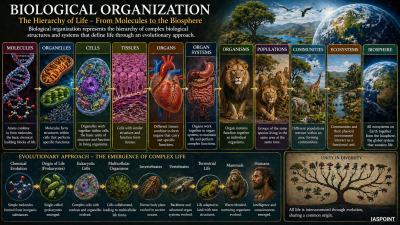
Biological organization represents the hierarchy of complex biological structures and systems that define life through an evolutionary approach.
Level 1: The Cellular Level (Basic Unit of Life)
The cell is the smallest structural and functional unit of an organism, capable of independent existence and performing the essential functions of life.
- Prokaryotic vs. Eukaryotic: Cells are broadly classified based on nuclear membrane presence. Prokaryotes (e.g., Bacteria) lack a defined nucleus, while Eukaryotes (e.g., Plants, Animals) possess membrane-bound organelles.
- Cell Organelles: Key structures include the Mitochondria (Powerhouse/ATP production), Ribosomes (Protein synthesis), and the Nucleus (Genetic repository).
- Significance in UPSC: Cellular biology is the basis for understanding DNA technology, vaccines, and stem cell research.
Level 2: The Tissue Level (Specialized Aggregations)
Tissues are groups of similar cells that work together to perform a specific function. Histology is the study of tissues.
- Animal Tissues:
- Epithelial Tissue: Covers body surfaces and lines cavities (e.g., skin, lining of the stomach).
- Connective Tissue: Supports and binds other tissues. Examples include Blood (fluid connective tissue), Bone, and Adipose (fat).
- Muscular Tissue: Responsible for movement (Skeletal, Smooth, and Cardiac).
- Nervous Tissue: Specialized for communication via electrical impulses (Neurons and Glia).
- Plant Tissues: Divided into Meristematic (active cell division) and Permanent (specialized functions like Xylem for water transport and Phloem for food transport).
Level 3: The Organ Level (Functional Integration)
An organ is a structure composed of two or more different types of tissues that work together to perform complex functions.
- Examples: The Heart contains muscular tissue to pump, nervous tissue to regulate rhythm, and connective tissue for structure. The Skin is considered the largest organ of the human body.
- Plant Organs: Roots, stems, leaves, and flowers are the primary organs of vascular plants.
Level 4: The Organ System Level (Coordinated Operations)
An organ system consists of a group of organs that cooperate to accomplish a common purpose for the survival of the organism.
| Organ System | Primary Organs | Key Functions for Prelims |
| Circulatory | Heart, Blood Vessels, Blood | Transport of nutrients, oxygen, and hormones. |
| Respiratory | Lungs, Trachea, Diaphragm | Exchange of O2 and CO2; pH regulation. |
| Digestive | Stomach, Intestines, Liver | Breakdown of complex molecules into absorbable units. |
| Endocrine | Pituitary, Thyroid, Adrenals | Slow-acting chemical coordination via hormones. |
| Excretory | Kidneys, Ureters, Bladder | Removal of nitrogenous wastes and osmoregulation. |
| Nervous | Brain, Spinal Cord, Nerves | Rapid coordination and sensory processing. |
Level 5: The Organismal Level
The organism is the highest level of organization in this specific hierarchy, representing the sum total of all structural levels working in tandem to maintain Homeostasis—the state of steady internal, physical, and chemical conditions maintained by living systems.
Comprehensive Comparison of Biological Hierarchy
| Level | Definition | Example (Human) | Example (Plant) |
| Cell | Basic structural unit | Myocyte (Muscle cell) | Guard Cell |
| Tissue | Group of similar cells | Cardiac Muscle | Mesophyll Tissue |
| Organ | Multiple tissues acting together | Heart | Leaf |
| System | Group of organs | Circulatory System | Shoot System |
| Organism | Independent living entity | Human Being | Oak Tree |
Facts and Trivia for UPSC Competitive Excellence
- Cytology and Histology: Robert Hooke first observed “cells” in 1665. The study of tissues (Histology) was pioneered by Xavier Bichat.
- Non-Cellular Life: Viruses are considered an exception to the Cell Theory as they are obligate intracellular parasites and lack a cellular structure.
- Fluid Connective Tissue: Blood is the only tissue in the human body that exists in a fluid state, crucial for the “Internal Environment” or Milieu intérieur.
- Regeneration Power: Different tissues have varying regenerative capacities. Epithelial tissues regenerate rapidly, while Nervous tissue has very limited regenerative ability in adults.
- The Totipotency Concept: In plants, many cells retain the ability to give rise to a whole new organism (Totipotency), a principle used extensively in Plant Tissue Culture (Biotechnology).