

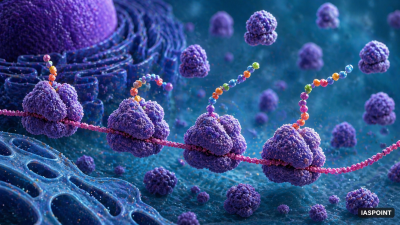
Ribosomes are small, dense, granular organelles responsible for protein synthesis. Unlike most other organelles, ribosomes are non-membrane bound, allowing them to exist in both prokaryotic and eukaryotic cells. They were first isolated and characterized by George Palade in 1953 (using an electron microscope), for which they are sometimes referred to as Palade granules.
Chemical Composition and Structure
Ribosomes are composed of two primary chemical constituents: Ribosomal RNA (rRNA) and Proteins. This combination classifies them as Ribonucleoprotein (RNP) particles.
- Two-Subunit Structure: Every ribosome consists of two unequal subunits—a Large Subunit and a Small Subunit. These subunits remain separate in the cytoplasm and only join together when they attach to a messenger RNA (mRNA) molecule to begin protein synthesis.
- Magnesium Ion Dependency: The association and dissociation of the two subunits depend on the concentration of Magnesium ions (Mg2+).
Classification: 70S vs. 80S Ribosomes
The “S” in ribosome types stands for the Svedberg Unit, a measure of the sedimentation coefficient (how fast a particle settles in a centrifuge), which indirectly indicates size and density.
| Feature | 70S Ribosomes | 80S Ribosomes |
| Occurrence | Prokaryotes (Bacteria), Mitochondria, and Chloroplasts | Eukaryotic Cytoplasm |
| Small Subunit | 30S | 40S |
| Large Subunit | 50S | 60S |
| Composition | ~60% RNA + 40% Protein | ~40% RNA + 60% Protein |
Primary Functions of Ribosomes
1. Protein Synthesis (Translation)
Ribosomes are the “Protein Factories” of the cell. They translate the genetic code carried by mRNA into a specific sequence of amino acids to form polypeptide chains (proteins).
2. Structural Scaffolding
The ribosome provides the physical sites (A, P, and E sites) where transfer RNA (tRNA) molecules can bring amino acids and match them to the mRNA codon.
3. Catalytic Activity
The ribosome acts as a Ribozyme. The large subunit contains an enzyme (peptidyl transferase) that catalyzes the formation of peptide bonds between amino acids.
Cellular Distribution
Ribosomes are found in different locations depending on the protein’s eventual destination:
- Free Ribosomes: Suspended in the cytosol; they synthesize proteins that function within the cytosol (e.g., enzymes for glycolysis).
- Bound Ribosomes: Attached to the Rough Endoplasmic Reticulum (RER) or the nuclear envelope; they synthesize proteins destined for insertion into membranes, packaging within organelles (like lysosomes), or export from the cell (secretion).
- Organellar Ribosomes: Found inside mitochondria and chloroplasts (specifically 70S), supporting the Endosymbiotic Theory that these organelles originated from ancient bacteria.
Essential Facts for UPSC Prelims
Polyribosomes (Polysomes)
In many instances, several ribosomes attach to a single mRNA strand simultaneously, appearing like “beads on a string.” This complex is called a Polysome, and it allows the cell to create multiple copies of the same protein very quickly.
Absence in Specific Cells
While ribosomes are nearly universal, they are absent in mature mammalian Red Blood Cells (RBCs), as these cells lose their organelles to accommodate maximum hemoglobin.
The Nucleolus Connection
In eukaryotes, the Nucleolus (located inside the nucleus) is the site where ribosomal RNA (rRNA) is synthesized and ribosomal subunits are assembled before being exported to the cytoplasm.
Trivia for Competitive Exams
- Universal Organelle: Ribosomes are the only organelles found in both Prokaryotic and Eukaryotic cells.
- Smallest Organelle: They are considered the smallest among all cell organelles.
- Antibiotic Target: Many antibiotics (like Tetracycline and Erythromycin) work by specifically targeting the 70S ribosomes of bacteria, inhibiting their protein synthesis without affecting the 80S ribosomes of the human host.