

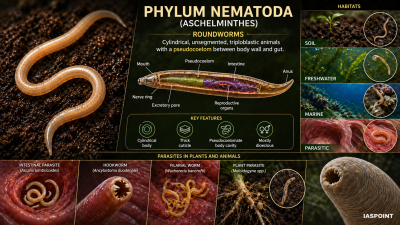
Phylum Nematoda, also known as Aschelminthes or Nemathelminthes, consists of organisms commonly called roundworms. The name is derived from the Greek nema (thread) and eidos (form). Unlike flatworms, nematodes possess a cylindrical body shape and represent a significant evolutionary step toward higher animal complexity. They are ubiquitous, found in soil, freshwater, marine habitats, and as parasites in plants and animals.
Morphological and Anatomical Characteristics
Body Structure and Symmetry
Nematodes exhibit bilateral symmetry and are triploblastic. Their most distinguishing feature is their circular cross-section, which gives them the name “roundworms.” The body is unsegmented and covered by a tough, resistant, non-living proteinaceous layer called the cuticle, which protects parasitic species from the host’s digestive enzymes.
The Pseudocoelom
Nematodes are categorized as Pseudocoelomates. This means they possess a body cavity, but it is not lined by mesoderm (unlike true coelomates). Instead, the mesoderm is present as scattered pouches between the ectoderm and endoderm. This cavity serves as a hydrostatic skeleton, providing structural support and aiding movement.
Physiological Systems
- Digestive System: They possess a complete alimentary canal with a well-developed muscular pharynx. This includes a distinct mouth and anus, allowing for a one-way flow of food—an evolutionary advancement over Platyhelminthes.
- Excretory System: Waste removal is facilitated by an excretory tube or specialized cells called Renette cells, which collect body waste and eliminate it through an excretory pore.
- Nervous System: Consists of a nerve ring (circumenteric ring) around the pharynx and longitudinal nerve cords.
- Respiratory and Circulatory Systems: These systems are absent. Gaseous exchange and nutrient transport occur via the fluid in the pseudocoelom through diffusion.
Classification and Examples
Nematodes are primarily classified based on the presence or absence of sensory organs called phasmids.
| Category | Common Name | Biological Name | Host/Habitat |
| Intestinal Parasite | Roundworm | Ascaris lumbricoides | Human small intestine |
| Tissue Parasite | Filarial worm | Wuchereria bancrofti | Lymphatic vessels of humans |
| Skin/Tissue Parasite | Guinea worm | Dracunculus medinensis | Subcutaneous tissues |
| Hookworm | Hookworm | Ancylostoma duodenale | Human intestine |
| Free-living | Vinegar eel | Turbatrix aceti | Fermenting vinegar |
Reproduction and Sexual Dimorphism
Nematodes are typically dioecious, meaning sexes are separate. They exhibit distinct sexual dimorphism, where males and females are morphologically different.
- Females: Usually longer and straighter.
- Males: Smaller than females, often with a curved posterior end and specialized structures called penial setae (spicules) for copulation. Fertilization is internal, and development may be direct (miniature adult) or indirect (involving larval stages).
UPSC Prelims: Essential Facts and Trivia
Biological Significance
- Tube-within-a-tube Plan: Nematodes are the first phylum to exhibit a complete digestive tract, establishing the “tube-within-a-tube” body plan.
- Hydrostatic Skeleton: The pressurized fluid in the pseudocoelom provides the rigidity necessary for their characteristic thrashing or whip-like movement.
- Ecdysis: Similar to arthropods, many nematodes undergo molting or ecdysis of their cuticle during growth.
Major Human Diseases
- Ascariasis: Caused by Ascaris lumbricoides. It is characterized by internal bleeding, muscular pain, fever, and blockage of the intestinal passage.
- Filariasis (Elephantiasis): Caused by Wuchereria bancrofti and W. malayi. These worms cause chronic inflammation of the lymphatic vessels, usually of the lower limbs, leading to massive swelling. It is transmitted via the bite of the Culex mosquito.
- Enterobiasis: Caused by the Pinworm (Enterobius vermicularis), common in children, leading to perianal itching.
Summary for Revision
- Level of Organization: Organ-system level.
- Symmetry: Bilateral.
- Body Cavity: Pseudocoelomate.
- Digestive Tract: Complete (Mouth to Anus).
- Sexes: Separate (Sexual dimorphism present).
- Unique Trait: Presence of a tough cuticle and muscular pharynx.