

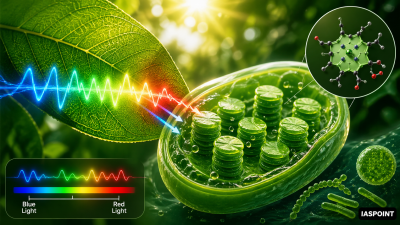
Chlorophyll is a green pigment found in the chloroplasts of plants, algae, and cyanobacteria. It is the essential molecule that enables photosynthesis by absorbing light energy, primarily from the blue and red portions of the electromagnetic spectrum, and converting it into chemical energy.
Chemical Structure and Composition
- Porphyrin Ring: The “head” of the chlorophyll molecule is a complex ring structure called a porphyrin ring. It is structurally similar to the heme group in hemoglobin.
- Central Metal Ion: Unlike hemoglobin which contains iron (Fe), chlorophyll has a single Magnesium (Mg2+) atom at the center of the porphyrin ring. This magnesium is vital for its light-absorbing properties.
- Phytol Tail: A long hydrophobic hydrocarbon tail that anchors the chlorophyll molecule into the thylakoid membrane of the chloroplast.
Types of Chlorophyll
While several types of chlorophyll exist, the most significant for UPSC aspirants are:
| Type | Occurrence | Primary Role |
| Chlorophyll-a | All oxygen-evolving photosynthetic organisms. | The Primary Photosynthetic Pigment; directly participates in light reactions. |
| Chlorophyll-b | Higher plants and green algae. | An Accessory Pigment; absorbs light of different wavelengths and transfers energy to Chlorophyll-a. |
| Chlorophyll-c | Diatoms and Brown Algae. | Accessory pigment; replaces Chlorophyll-b in these groups. |
| Chlorophyll-d & f | Certain Cyanobacteria. | Absorbs far-red light, allowing photosynthesis in deep water or shaded environments. |
Mechanism of Action
Chlorophyll molecules are organized into Photosystems (PS I and PS II) located in the thylakoid membranes.
- Absorption of Light: When a photon of light hits a chlorophyll molecule, it excites an electron to a higher energy state.
- Reaction Center: Chlorophyll-a forms the reaction center of the photosystem where the energy is funneled to initiate the electron transport chain.
- Photolysis: The energy captured by chlorophyll is used to split water molecules (H2O), releasing oxygen (O2), protons, and electrons.
Factors Affecting Chlorophyll Synthesis
- Light: Most plants require light to trigger the synthesis of chlorophyll. In the absence of light, plants become “etiolated” (pale and weak).
- Mineral Nutrition: Since Magnesium is the central atom, its deficiency (and also Iron or Nitrogen deficiency) leads to Chlorosis—the yellowing of leaves due to inadequate chlorophyll production.
- Temperature: High temperatures can inhibit synthesis or cause the breakdown of existing chlorophyll.
UPSC Prelims Fact File and Trivia
- Absorption Spectrum: Chlorophyll absorbs light most efficiently in the blue (430nm) and red (660nm) regions. It reflects green light, which is why leaves appear green to the human eye.
- Accessory Pigments: Besides chlorophyll, plants use Carotenoids and Xanthophylls to protect chlorophyll from photo-oxidation (solarization) and to widen the range of light wavelengths that can be used.
- Bacteriochlorophyll: Found in phototrophic bacteria (like purple bacteria); these do not produce oxygen during photosynthesis (anoxygenic photosynthesis).
- Magnesium’s Role: Without Magnesium, the plant cannot capture sun energy. Magnesium also acts as an enzyme activator for several respiratory and photosynthetic enzymes.
- Autumn Colors: In autumn, the decrease in temperature and light causes chlorophyll to break down. This unmasks the accessory pigments (carotenoids), leading to the yellow, orange, and red hues seen in deciduous forests.