

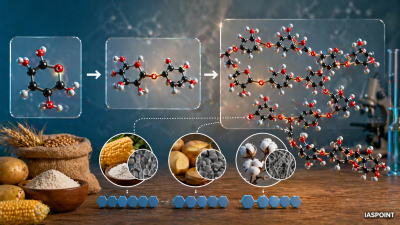
Polysaccharides, or glycans, are complex carbohydrates formed by the polymerization of hundreds to thousands of monosaccharide units joined by glycosidic bonds. They are characterized by high molecular weight and are categorized as biomacromolecules. Unlike sugars, polysaccharides are generally insoluble in water and do not taste sweet.
Classification Based on Composition
Polysaccharides are classified into two main types based on the variety of monosaccharides present in their chain.
- Homopolysaccharides: Composed of a single type of monosaccharide monomer. Examples include Starch, Glycogen, Cellulose, and Chitin.
- Heteropolysaccharides: Composed of two or more different types of monosaccharides or their derivatives. Examples include Hyaluronic acid, Heparin, and Peptidoglycan.
Storage Polysaccharides
These serve as energy reserves that can be hydrolyzed into glucose when the organism requires metabolic fuel.
Starch
- Source: Primary storage form of glucose in plants (found in cereals, legumes, and tubers).
- Composition: Consists of two components:
- Amylose: A linear, unbranched polymer with α(1 → 4) glycosidic bonds. It forms a helical structure.
- Amylopectin: A branched polymer with α(1 → 4) bonds in the chain and α(1 → 6) bonds at the branch points.
- Detection: Starch gives a characteristic blue-black color with Iodine because the I2 molecules get trapped within the amylose helices.
Glycogen
- Source: Primary storage form of glucose in animals (stored in liver and muscles) and fungi.
- Structure: Often called “Animal Starch,” it is structurally similar to amylopectin but significantly more highly branched.
- Function: It is rapidly mobilized by the hormone glucagon to maintain blood glucose levels.
Structural Polysaccharides
These provide mechanical strength and protection to cells and organisms.
Cellulose
- Source: The main structural component of plant cell walls.
- Structure: A linear, unbranched homopolymer of β-D-glucose linked by β(1 → 4) glycosidic bonds.
- Properties: Unlike starch, cellulose does not form helices; it forms straight chains that bundle into microfibrils.
- UPSC Fact: It is the most abundant organic polymer on Earth. Humans cannot digest it because they lack the enzyme cellulase, though it serves as vital dietary fiber (roughage).
Chitin
- Source: Found in the exoskeletons of arthropods (insects, crabs) and the cell walls of fungi.
- Structure: A homopolymer of N-acetylglucosamine (a nitrogen-containing derivative of glucose).
- Significance: It is the second most abundant organic polymer in nature and provides exceptional structural rigidity.
Comparative Overview of Major Polysaccharides
| Polysaccharide | Monomer | Linkage Type | Function |
| Starch | α-Glucose | α(1 → 4) & α(1 → 6) | Energy storage in plants |
| Glycogen | α-Glucose | α(1 → 4) & α(1 → 6) | Energy storage in animals |
| Cellulose | β-Glucose | β(1 → 4) | Plant cell wall structure |
| Chitin | N-acetylglucosamine | β(1 → 4) | Exoskeleton and Fungal walls |
| Inulin | Fructose | β(2 → 1) | Storage in some plants (e.g., Dahlia) |
Other Biologically Important Polysaccharides
- Agar (Agar-Agar): Derived from red algae (Gelidium and Gracilaria). It is used as a solidifying agent in microbiology culture media and in the food industry.
- Pectin: Found in the middle lamella of plant cell walls; it acts as a “cellular glue.” It is used commercially to make jellies.
- Hyaluronic Acid: A heteropolysaccharide found in the vitreous humor of the eye and synovial fluid of joints, acting as a lubricant and shock absorber.
- Heparin: An anticoagulant found in the blood that prevents internal clotting.
Fact File for UPSC Prelims
- Paper and Cotton: Paper made from plant pulp is primarily cellulose. Cotton fiber is almost 90-95% pure cellulose.
- The Iodine Test Limitation: Cellulose cannot hold I2 molecules because it lacks a helical secondary structure; therefore, it does not change color with iodine.
- Complex Heteropolymers: Most bacterial cell walls are made of Peptidoglycan, a complex heteropolymer of sugars and amino acids.
- Dextran: A complex branched glucan used as an antithrombotic (to reduce blood viscosity) and as a plasma volume expander in hypovolemic shock.