

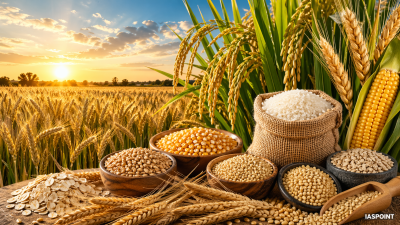
Cereals are members of the Poaceae (Gramineae) family, commonly known as the grass family. They are cultivated primarily for their edible starchy seeds, known as caryopsis. Economically, cereals form the backbone of global food security, providing the highest percentage of caloric intake for the human population.
Major Cereals: Rice, Wheat, and Maize
Oryza sativa (Rice)
Rice is the staple food for more than half of the world’s population, particularly in Asia.
- Origin: South-East Asia (Indo-Burma region).
- Botanical Features: An annual grass with a fibrous root system and an inflorescence called a panicle.
- Nutritional Fact: Rice is rich in carbohydrates but relatively low in protein (7%). Polished rice often loses Vitamin B1 (Thiamine), leading to diseases like Beri-beri.
- Cultivation Types:
- Aus: Autumn rice (Sown May-June).
- Aman: Winter rice (Sown June-July) – most common in India.
- Boro: Summer rice (Sown Nov-Dec).
Triticum aestivum (Wheat)
Wheat is considered the “King of Cereals” and is the primary food crop in temperate regions.
- Origin: South-West Asia (Levant region).
- Genetics: Most commercial wheat is hexaploid (2n = 6x = 42).
- Protein Content: Contains Gluten, a protein complex that provides elasticity to dough, essential for bread making.
- Varieties:
- Hard Wheat: High gluten content, used for bread.
- Soft Wheat: Low gluten, used for biscuits and cakes.
- Durum Wheat: Used for pasta and semolina.
Zea mays (Maize/Corn)
Maize is unique among cereals as it is a monoecious plant (separate male and female flowers on the same plant).
- Origin: Central America (Mexico).
- Inflorescence: The male inflorescence is the Tassel (terminal), and the female is the Cob/Ear (axillary).
- Industrial Use: Major source of starch, glucose, and bio-ethanol. It lacks the amino acids tryptophan and lysine.
Comparative Analysis of Major Cereals
| Feature | Rice (Oryza sativa) | Wheat (Triticum aestivum) | Maize (Zea mays) |
| Inflorescence | Panicle | Spike | Tassel (M) & Cob (F) |
| Ideal Climate | Tropical/Humid | Temperate/Cool | Sub-tropical/Warm |
| Fruit Type | Caryopsis | Caryopsis | Caryopsis |
| Main Protein | Oryzenin | Glutenin & Gliadin | Zein |
| Self/Cross Pollination | Self-pollinated | Self-pollinated | Cross-pollinated |
Millets: The “Nutri-Cereals”
Millets are small-seeded grasses often referred to as “orphan crops” or “coarse cereals.” They are highly resilient to drought and nutritionally superior to rice and wheat.
Major Millets
- Sorghum bicolor (Jowar): The third most important cereal in India. It is a C4 plant with high photosynthetic efficiency.
- Pennisetum glaucum (Bajra/Pearl Millet): Highly drought-tolerant; thrives in sandy soils of Rajasthan. Rich in Iron and Zinc.
- Eleusine coracana (Ragi/Finger Millet): Highest Calcium content among all cereals. Ideal for bone health and diabetic patients.
Minor Millets
- Foxtail Millet (Kakun): Setaria italica
- Barnyard Millet (Sanwa): Echinochloa frumentacea
- Kodo Millet (Kodo): Paspalum scrobiculatum
- Little Millet (Kutki): Panicum sumatrense
Pseudo-Cereals: Botanical Exceptions
Pseudo-cereals are broad-leaf plants (non-grasses) whose seeds are used similarly to true cereals. They do not belong to the Poaceae family.
- Buckwheat (Kuttu): Fagopyrum esculentum (Family: Polygonaceae). Rich in Lysine and gluten-free.
- Amaranth (Rajgira): Amaranthus spp. (Family: Amaranthaceae). Known for high protein quality.
- Quinoa: Chenopodium quinoa (Family: Amaranthaceae). Contains all nine essential amino acids.
Economic Botany and UPSC Trivia
- The Hull: The outer covering of the rice grain (lemma and palea). Rice bran oil is extracted from the bran layer and is rich in Oryzanol, which lowers cholesterol.
- Golden Rice: A genetically modified variety of rice (Oryza sativa) produced to biosynthesize Beta-carotene, a precursor of Vitamin A.
- Triticale: The first man-made cereal, produced by crossing Wheat (Triticum) and Rye (Secale).
- C4 vs C3 Metabolism: Maize, Sorghum, and Sugarcane are C4 plants (efficient in high temperatures), while Rice and Wheat are C3 plants.
- International Year of Millets: The United Nations declared 2023 as the International Year of Millets, following a proposal by India to promote these climate-resilient crops.
- Biofortification: The process of increasing the nutritional value of crops (e.g., Shakti, Protina, and Rattan are high-lysine maize varieties).