

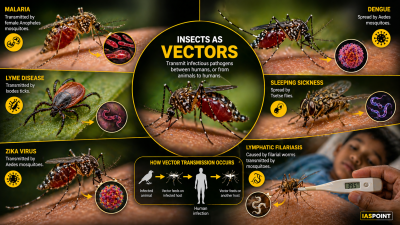
Insects act as vectors, which are living organisms that can transmit infectious pathogens between humans, or from animals to humans.
1. Dipteran Vectors (Mosquitoes and Flies)
The order Diptera contains the most significant disease vectors affecting global public health.
Mosquito-Borne Diseases
- Anopheles Mosquito: Acts as the vector for Malaria, caused by the protozoan Plasmodium. Note: Only the female Anopheles transmits the disease as she requires blood meals for egg production.
- Aedes aegypti: Known as the “Tiger Mosquito,” it transmits several viral diseases:
- Dengue: Caused by the Dengue virus.
- Chikungunya: Caused by the Chikungunya virus.
- Zika Virus: Linked to microcephaly in newborns.
- Yellow Fever: Primarily found in tropical regions of Africa and South America.
- Culex Mosquito: Transmits Japanese Encephalitis and Lymphatic Filariasis (Elephantiasis), the latter caused by the filarial worm Wuchereria bancrofti.
Fly-Borne Diseases
- Housefly (Musca domestica): Acts as a mechanical vector (carrying pathogens on its legs and mouthparts) for Cholera, Typhoid, and Amoebic Dysentery.
- Sandfly (Phlebotomus): Transmits Kala-azar (Visceral Leishmaniasis), caused by the protozoan Leishmania donovani. This is a significant public health issue in states like Bihar and West Bengal.
- Tsetse Fly (Glossina): Transmits Sleeping Sickness (African Trypanosomiasis) in sub-Saharan Africa, caused by Trypanosoma.
2. Other Arthropod Vectors
Beyond flies and mosquitoes, other classes of arthropods are responsible for spreading severe infections.
Fleas, Lice, and Bugs
- Rat Flea (Xenopsylla cheopis): The vector for Bubonic Plague, caused by the bacterium Yersinia pestis. It spreads the bacteria from infected rodents to humans.
- Body Louse (Pediculus humanus): Transmits Epidemic Typhus, caused by Rickettsia prowazekii.
- Kissing Bug (Triatomine bug): Transmits Chagas Disease, prevalent in the Americas, caused by Trypanosoma cruzi.
Arachnid Vectors (Non-Insect Arthropods)
- Ticks: Transmit Kyasanur Forest Disease (KFD) or “Monkey Fever” in India (specifically Karnataka). They also transmit Lyme Disease (caused by Borrelia bacteria).
- Mites: Transmit Scrub Typhus, a significant rickettsial infection in Southeast Asia and India.
Summary Table: Pathogens and Vectors
| Disease | Vector (Insect/Arthropod) | Pathogen Type | Pathogen Name |
| Malaria | Female Anopheles | Protozoa | Plasmodium sp. |
| Kala-azar | Sandfly | Protozoa | Leishmania donovani |
| Plague | Rat Flea | Bacteria | Yersinia pestis |
| Dengue | Aedes aegypti | Virus | Flavivirus |
| Filariasis | Culex mosquito | Helminth (Worm) | Wuchereria bancrofti |
| Sleeping Sickness | Tsetse Fly | Protozoa | Trypanosoma brucei |
Defensive Mechanisms and Control
- Biological Control: Introduction of Gambusia fish (Mosquito fish) into ponds to feed on mosquito larvae.
- Chemical Control: Use of Indoor Residual Spraying (IRS) and insecticide-treated nets.
- Sterile Insect Technique (SIT): A method where sterile male insects are released into the wild to mate with females, resulting in no offspring and a population decline.
Fact Sheet for UPSC Prelims
- Zoonotic Shift: Many insect-borne diseases like KFD (Monkey Fever) are zoonotic, meaning they jump from animal populations to humans.
- Wolbachia Method: A modern biological intervention where Aedes aegypti mosquitoes are infected with Wolbachia bacteria, which prevents them from transmitting viruses like Dengue.
- Vector Competence: This refers to the ability of a vector to acquire, maintain, and transmit a pathogen. Not all mosquitoes can transmit all viruses.
- Primary vs. Secondary Vector: A primary vector is the main organism spreading a disease in an area, while a secondary vector contributes to the spread but is not the main driver.