

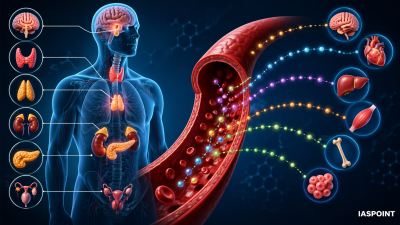
The endocrine system is a complex network of ductless glands that secrete chemical messengers known as hormones directly into the bloodstream. Unlike the exocrine system, which uses ducts (e.g., salivary or sweat glands), the endocrine system relies on the circulatory system to transport hormones to distant target organs to maintain homeostasis, regulate metabolism, and manage growth.
Master Regulators: Hypothalamus and Pituitary Gland
The Hypothalamus
Often called the “Master of the Master Gland,” the hypothalamus bridges the nervous and endocrine systems. It produces releasing and inhibiting hormones that control the anterior pituitary.
- Key Hormones: Thyrotropin-releasing hormone (TRH), Gonadotropin-releasing hormone (GnRH), and Somatostatin.
- Direct Production: It synthesizes Oxytocin and Vasopressin (ADH), which are stored and released by the posterior pituitary.
The Pituitary Gland (Hypophysis)
Located in the sella turcica of the sphenoid bone, it is divided into the Adenohypophysis (Anterior) and Neurohypophysis (Posterior).
| Part | Hormone | Primary Function |
| Anterior | Growth Hormone (GH) | Body growth and protein synthesis; excess causes Gigantism/Acromegaly. |
| Anterior | Prolactin (PRL) | Growth of mammary glands and milk formation. |
| Anterior | TSH | Stimulates synthesis and secretion of thyroid hormones. |
| Anterior | ACTH | Stimulates glucocorticoids from the adrenal cortex. |
| Anterior | LH & FSH | Regulate gonadal activity (Gonadotropins). |
| Posterior | Oxytocin | Smooth muscle contraction; “Birth Hormone” and milk ejection. |
| Posterior | Vasopressin (ADH) | Water resorption in kidneys; deficiency causes Diabetes Insipidus. |
The Thyroid and Parathyroid Glands
Thyroid Gland
Located on either side of the trachea, it is the largest endocrine gland. It is composed of follicles and stromal tissues.
- Hormones: Thyroxine (T4) and Triiodothyronine (T3).
- Iodine Requirement: Essential for normal hormone synthesis. Deficiency leads to Goitre and hypothyroidism (Cretinism in children).
- Thyrocalcitonin (TCT): A protein hormone that lowers blood calcium levels.
Parathyroid Glands
Four small glands present on the back side of the thyroid gland.
- Parathyroid Hormone (PTH): A hypercalcemic hormone that increases blood Ca2+ levels by mobilizing calcium from bones and increasing resorption in renal tubules.
The Adrenal Glands (Suprarenal Glands)
Located at the anterior part of each kidney, they consist of two types of tissues: the central Adrenal Medulla and the outer Adrenal Cortex.
Adrenal Medulla
Secretes Catecholamines (Emergency hormones or “3F” – Fight, Flight, Fright).
- Adrenaline (Epinephrine) & Noradrenaline: Increase heartbeat, alertness, pupillary dilation, and piloerection.
Adrenal Cortex
Divided into three layers: Zona reticularis (inner), Zona fasciculata (middle), and Zona glomerulosa (outer).
- Glucocorticoids (e.g., Cortisol): Involved in carbohydrate metabolism and anti-inflammatory reactions.
- Mineralocorticoids (e.g., Aldosterone): Regulate water and electrolyte balance (Sodium/Potassium).
- Clinical Fact: Damage to the adrenal cortex leads to Addison’s disease, characterized by acute fatigue and hypoglycemia.
Pancreas: The Composite Gland
The pancreas acts as both exocrine and endocrine (Heterocrine gland). The endocrine part consists of the Islets of Langerhans.
- Alpha (α) cells: Secrete Glucagon, a hyperglycemic hormone that stimulates glycogenolysis in the liver.
- Beta (β) cells: Secrete Insulin, a hypoglycemic hormone that enhances cellular glucose uptake.
- Clinical Fact: Prolonged hyperglycemia leads to Diabetes Mellitus, associated with loss of glucose through urine and ketone body formation.
Gonadal Glands: Testis and Ovary
Testis (Male)
Located in the scrotal sac, it performs dual functions as a primary sex organ and endocrine gland.
- Leydig Cells: Produce Androgens (Testosterone).
- Functions: Regulate male secondary sexual characteristics, spermatogenesis, and anabolic effects on protein metabolism.
Ovary (Female)
Located in the abdomen, producing ova and two groups of steroid hormones.
- Estrogen: Synthesized by growing ovarian follicles; governs female secondary sex organs and mammary gland development.
- Progesterone: Secreted by the Corpus Luteum; supports pregnancy and acts on mammary glands to stimulate milk secretion (alveoli formation).
Other Endocrine Organs and Trivia
The Pineal Gland
Located on the dorsal side of the forebrain.
- Melatonin: Regulates the 24-hour (diurnal) rhythm of the body, sleep-wake cycle, and body temperature.
The Thymus
A lobular structure located between the lungs behind the sternum.
- Thymosins: Play a major role in the differentiation of T-lymphocytes (Cell-mediated immunity).
- UPSC Note: The thymus degenerates in old individuals, leading to weakened immune responses in the elderly.
Hormones of Heart, Kidney, and GI Tract
- Atrial Natriuretic Factor (ANF): Secreted by the heart wall to decrease blood pressure (vasodilation).
- Erythropoietin: Secreted by the Juxtaglomerular cells of the kidney to stimulate RBC formation (Erythropoiesis).
- Gastrin, Secretin, CCK: Secreted by the gastrointestinal mucosa to regulate digestive juice secretion.