

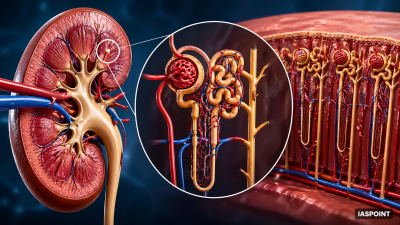
The nephron is the microscopic structural and functional unit of the kidney. Each human kidney contains approximately one million nephrons, which are responsible for removing waste products and excess substances from the blood.
Components of the Nephron
A nephron consists of two major segments: the Renal Corpuscle and the Renal Tubule.
1. Renal Corpuscle (Malpighian Body)
- Glomerulus: A high-pressure capillary bed formed by the afferent arteriole. It acts as the primary site of filtration.
- Bowman’s Capsule: A double-walled, cup-shaped epithelial socket that encloses the glomerulus. The inner wall consists of specialized cells called podocytes which form filtration slits.
2. Renal Tubule System
- Proximal Convoluted Tubule (PCT): Lined with simple cuboidal brush border epithelium, which maximizes the surface area for reabsorption.
- Henle’s Loop: A U-shaped portion consisting of a thin descending limb (permeable to water) and a thick ascending limb (permeable to electrolytes).
- Distal Convoluted Tubule (DCT): A highly coiled region where conditional reabsorption of sodium and water occurs under hormonal influence.
- Collecting Duct: A long straight tube where many nephrons converge; it facilitates the final concentration of urine.
The Process of Excretion (Urine Formation)
Excretion involves three well-defined physiological steps that ensure metabolic waste is removed while essential nutrients and water are conserved.
I. Glomerular Filtration (Ultrafiltration)
- Mechanism: Blood is filtered under high pressure through the three layers of the filtration membrane: the endothelium of glomerular blood vessels, the epithelium of Bowman’s capsule, and the basement membrane between them.
- Filtrate Composition: The resulting “glomerular filtrate” is nearly identical to blood plasma but lacks proteins and cellular elements.
- Volume: About 1100-1200 ml of blood is filtered by the kidneys per minute.
II. Selective Reabsorption
- Efficiency: Nearly 99% of the 180 liters of daily filtrate is reabsorbed by the renal tubules.
- Active Transport: Glucose, amino acids, and Na^+ are reabsorbed actively.
- Passive Transport: Nitrogenous wastes and water (in certain segments) are reabsorbed passively.
- Segment-wise Role: The PCT is the site of maximum reabsorption (70-80% of electrolytes and water).
III. Tubular Secretion
- Mechanism: Tubular cells secrete substances like H^+, K^+, and NH3 into the filtrate.
- Significance: This step is crucial for maintaining the ionic balance and pH of body fluids.
Concentration of the Filtrate: Counter-Current Mechanism
To conserve water, mammals have the ability to produce concentrated urine. This is achieved by the Counter-Current Mechanism involving the Loop of Henle and the Vasa Recta.
- Counter-Current Flow: The flow of filtrate in the two limbs of Henle’s loop and the flow of blood in the two limbs of vasa recta are in opposite directions.
- Osmolarity Gradient: This mechanism maintains an increasing osmolarity towards the inner medullary interstitium (from 300 mOsmol/L to 1200 mOsmol/L).
- Final Result: Humans can produce urine nearly four times concentrated than the initial glomerular filtrate.
Regulation of Kidney Function
Kidney activity is monitored and regulated by hormonal feedback mechanisms involving the Hypothalamus, JGA, and the Heart.
| Regulator | Trigger | Action/Effect |
| ADH (Vasopressin) | Excessive loss of body fluid | Increases water reabsorption in DCT and Collecting Duct; prevents diuresis. |
| RAAS (Renin) | Fall in Glomerular Blood Pressure | Renin converts Angiotensinogen to Angiotensin II (a powerful vasoconstrictor). |
| Aldosterone | Angiotensin II stimulation | Increases reabsorption of Na^+ and water from DCT. |
| ANF (Atrial Natriuretic Factor) | Increase in blood pressure | Causes vasodilation to check the RAAS mechanism and lower blood pressure. |
Key Facts for UPSC Prelims
- Micturition: The voluntary/involuntary reflex of emptying the urinary bladder.
- Specific Gravity: Urine has a specific gravity of 1.001 to 1.035.
- Erythropoietin: A hormone produced by the kidney that stimulates RBC production in bone marrow.
- Juxtaglomerular Apparatus (JGA): A sensitive region formed by cellular modifications in the DCT and the afferent arteriole at the point of their contact.