

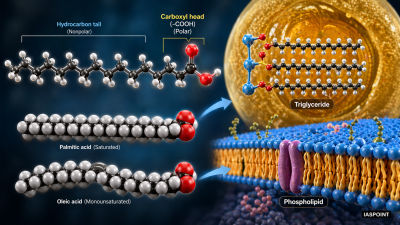
Fatty acids are organic acid molecules that serve as the fundamental building blocks of most lipids. Chemically, they consist of a long hydrocarbon chain (the “tail”) ending in a carboxyl group (-COOH) (the “head”). In biological systems, fatty acids rarely exist in a free state and are typically found esterified to glycerol in the form of triglycerides or phospholipids.
Structural Characteristics
- Carbon Chain Length: Most naturally occurring fatty acids have an even number of carbon atoms, usually ranging from 14 to 24.
- The Carboxyl Group: This functional group (-COOH) provides the acidic property to the molecule.
- The Hydrocarbon Tail: This part is non-polar and hydrophobic (water-repelling), which dictates the solubility of lipids in water.
Classification of Fatty Acids
Fatty acids are primarily classified based on the presence and number of double bonds between carbon atoms in their hydrocarbon chain.
1. Saturated Fatty Acids (SFAs)
These contain only single bonds between the carbon atoms. The chain is “saturated” with hydrogen atoms.
- Physical State: They have higher melting points and are typically solid at room temperature.
- Sources: Predominantly found in animal fats (butter, lard) and certain tropical oils (coconut oil, palm oil).
- Examples: Palmitic acid ($16$ carbons), Stearic acid ($18$ carbons).
2. Unsaturated Fatty Acids (UFAs)
These contain one or more double bonds (C = C) in the carbon chain, which creates “kinks” in the structure.
- Physical State: They have lower melting points and are typically liquid at room temperature (oils).
- Monounsaturated Fatty Acids (MUFA): Contain exactly one double bond. Example: Oleic acid.
- Polyunsaturated Fatty Acids (PUFA): Contain two or more double bonds. Examples: Linoleic acid, Linolenic acid.
Essential vs. Non-Essential Fatty Acids
From a nutritional and physiological standpoint for UPSC, the distinction between essential and non-essential fatty acids is critical.
- Essential Fatty Acids (EFAs): These cannot be synthesized by the human body because humans lack the enzymes to insert double bonds beyond the C-9 position. They must be obtained through diet.
- Linoleic Acid: An Omega-6 fatty acid.
- Alpha-Linolenic Acid (ALA): An Omega-3 fatty acid.
- Non-Essential Fatty Acids: These can be synthesized by the body from other dietary components (e.g., Palmitic acid).
Omega Fatty Acids: The Naming Convention
The “Omega” (w) notation refers to the position of the first double bond, counting from the methyl (-CH3) end of the carbon chain, rather than the carboxyl end.
- Omega-3 (w-3): First double bond at the third carbon. Found in fish oil, flaxseeds, and walnuts.
- Omega-6 (w-6): First double bond at the sixth carbon. Found in vegetable oils like sunflower and corn oil.
Important Fatty Acids and Their Carbon Counts
| Fatty Acid | Type | Carbon Atoms | Notable Source/Fact |
| Butyric Acid | Saturated | 4 | Found in rancid butter. |
| Palmitic Acid | Saturated | 16 | Most common SFA in plants and animals. |
| Arachidic Acid | Saturated | 20 | Found in peanut oil. |
| Oleic Acid | MUFA | 18 | Predominant in olive oil. |
| Arachidonic Acid | PUFA | 20 | Precursor for Prostaglandins (local hormones). |
Physiological Importance
- Energy Production: Through a process called β-oxidation in the mitochondria, fatty acids are broken down to generate large amounts of ATP.
- Cell Membrane Integrity: Phospholipids containing unsaturated fatty acids maintain the fluidity of the cell membrane.
- Precursors: Essential fatty acids are precursors to Eicosanoids (Prostaglandins, Leukotrienes), which regulate inflammation, blood pressure, and blood clotting.
UPSC Prelims Fact File
- Hydrogenation: The industrial process of adding hydrogen to unsaturated vegetable oils to make them solid (e.g., Vanaspati Ghee). This often produces Trans Fats, which are harmful to cardiovascular health.
- Amphipathic Nature: While fatty acids themselves are mostly hydrophobic, when they form phospholipids, they create molecules with a hydrophilic head and hydrophobic tail, essential for forming the lipid bilayer.
- Melting Point Trend: In fatty acids, the melting point increases with chain length but decreases significantly with the addition of double bonds.
- Prostaglandins: Derived from Arachidonic acid, these “local hormones” are the targets of common painkillers like Aspirin and Ibuprofen.