

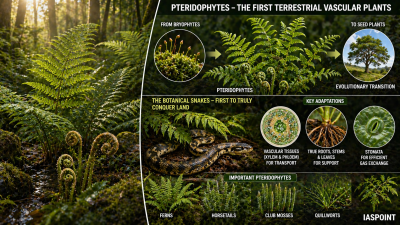
Pteridophytes represent the first group of terrestrial vascular plants, marking a significant evolutionary transition from the non-vascular bryophytes. Unlike bryophytes, which are the “amphibians of the plant kingdom,” pteridophytes are often referred to as the botanical snakes because they were the first to truly conquer land by developing specialized conducting tissues.
Fundamental Characteristics for UPSC Prelims
Pteridophytes are primitive seedless vascular plants that reproduce via spores. They thrive in cool, damp, and shady places, though some species have adapted to sandy soil conditions.
- Vascular System: They possess Xylem and Phloem for the conduction of water and food. However, the xylem lacks true vessels, and the phloem lacks companion cells and sieve tubes in most species.
- Plant Body: The main plant body is a Sporophyte (2n), which is differentiated into true roots, stem, and leaves. This is a major shift from bryophytes, where the dominant phase is the gametophyte.
- Leaf Types:
- Microphylls: Small leaves as seen in Selaginella.
- Macrophylls: Large leaves (fronds) as seen in Ferns.
- Reproduction: They do not produce flowers or seeds, making them Cryptogams (hidden reproduction).
The Life Cycle: Alternation of Generations
The life cycle of a pteridophyte is Diplohaplontic, characterized by a dominant sporophyte phase and a shorter-lived, independent gametophyte phase.
Sporophylls and Sporangia
Sporangia are produced on specialized leaves called sporophylls. In some cases, sporophylls form distinct compact structures called strobili or cones (e.g., Selaginella, Equisetum). The sporangia produce spores by meiosis in spore mother cells.
The Prothallus
The spores germinate to give rise to a multicellular, free-living, mostly photosynthetic thalloid gametophyte called the prothallus.
- Requirement: The prothallus requires cool, damp, and shady places to grow.
- Water Dependency: This specific requirement and the need for water for fertilization restrict the spread of living pteridophytes to narrow geographical regions.
Fertilization Process
The gametophytes bear male sex organs (Antheridia) and female sex organs (Archegonia). Water is essential for the transfer of antherozoids (male gametes) to the mouth of the archegonium. Fusion results in a zygote, which develops into a multicellular, well-differentiated sporophyte.
Classification of Pteridophytes
The group is divided into four primary classes based on morphological and structural differences:
| Class | Common Name / Examples | Key Features |
| Psilopsida | Psilotum | Most primitive; lack true roots; rhizoids present. |
| Lycopsida | Selaginella (Spike moss), Lycopodium (Club moss) | Possession of microphylls; some are heterosporous. |
| Sphenopsida | Equisetum (Horsetail) | Joined stems with silica deposits; possess strobili. |
| Pteropsida | Pteris, Dryopteris, Adiantum (Walking fern) | Largest group; possess macrophylls (fronds). |
Homospory vs. Heterospory: A Precursor to Seed Habit
A critical concept for UPSC is the distinction between spore types, as it relates to the evolution of the seed habit.
- Homosporous: Most pteridophytes produce spores of similar kinds (e.g., Dryopteris).
- Heterosporous: Certain genera produce two kinds of spores: Macro (large) spores and Micro (small) spores. Examples include Selaginella and Salvinia.
- Evolutionary Significance: In heterosporous species, the female gametophyte is retained on the parent sporophyte for variable periods. The development of the zygote into young embryos takes place within the female gametophyte. This event is considered a vital precursor to the seed habit found in Gymnosperms and Angiosperms.
Economic and Ecological Importance
Pteridophytes serve several roles beyond their evolutionary placement:
- Medicinal Uses: Many ferns are used for pharmacological purposes.
- Soil Binders: Their extensive root systems prevent soil erosion on hilly terrains.
- Ornamentals: Often grown in gardens for their aesthetic foliage (e.g., Ferns).
- Bio-fertilizers: Azolla (a water fern) lives in symbiotic association with the nitrogen-fixing cyanobacteria Anabaena azollae, making it an excellent bio-fertilizer for paddy fields.
Comparative Overview: Bryophytes vs. Pteridophytes
| Feature | Bryophytes | Pteridophytes |
| Dominant Phase | Gametophyte (n) | Sporophyte (2n) |
| Vascular Tissue | Absent | Present (Xylem & Phloem) |
| Roots | Rhizoids present | True Roots present |
| Habitat | Moist, terrestrial (Amphibians) | Moist, cool (First Vascular land plants) |
| Seed Habit | No trace | Precursor observed (Heterospory) |
Notable Trivia for Prelims
- Walking Fern: Adiantum is known as the “walking fern” because it propagates vegetatively when the leaf tips touch the soil and develop new plants.
- Resurrection Plant: Selaginella lepidophylla can survive extreme desiccation and “come back to life” when moisture is available.
- Living Fossil: Psilotum is often regarded as a living fossil due to its primitive features.