

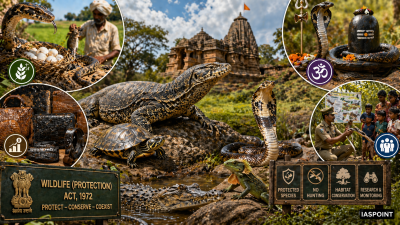
Reptiles serve as vital components of the Earth’s ecosystems and provide significant direct and indirect economic benefits to human society. In the context of India, they are also central to cultural heritage and various conservation programs under the Wildlife (Protection) Act, 1972.
1. Ecological Importance: Ecosystem Regulators
Reptiles play indispensable roles in maintaining the balance of food webs as both specialized predators and prey.
- Biological Pest Control: Snakes are primarily carnivorous and prey on rodents (rats and mice) and insects. By controlling rodent populations, they prevent the destruction of food grains and reduce the spread of zoonotic diseases like Plague and Leptospirosis.
- Apex Predators: Large reptiles like the Saltwater Crocodile and King Cobra regulate the populations of smaller carnivores and herbivores, preventing overgrazing and maintaining the health of aquatic and forest ecosystems.
- Bio-indicators: Reptiles are highly sensitive to environmental changes (pollution, temperature shifts, and habitat loss). The presence or absence of specific species, like the Gharial in the Chambal River, indicates the health of the riverine ecosystem.
- Nutrient Cycling: Reptiles contribute to nutrient cycling through their metabolic processes and by serving as food for higher-order predators like raptors (eagles/hawks) and larger mammals.
2. Economic Importance: Direct Benefits
The economic value of reptiles spans medicine, agriculture, and the luxury trade.
- Pharmaceutical Applications (Venom Research): * Snake venom is a complex mixture of proteins and enzymes used to produce Antivenom (ASV).
- Venom components are utilized in developing drugs for hypertension, blood clotting disorders, and even certain types of cancer. For example, the drug Captopril (for high blood pressure) was derived from the venom of a Brazilian pit viper.
- Agriculture: As natural “pest controllers,” snakes provide a free service to farmers. Estimates suggest that without snakes, rodent damage to Indian agriculture would increase exponentially.
- Leather and Fashion Industry: While largely regulated or banned today, the skins of crocodiles, snakes, and lizards have historically been a major source of revenue for the luxury leather industry. Under CITES, international trade is strictly monitored.
- Ecotourism: Wildlife sanctuaries focused on reptiles, such as Bhitarkanika (Odisha) for crocodiles and Agumbe (Karnataka) for King Cobras, generate significant revenue through tourism and research grants.
3. Reptiles in Medicine and Research
Reptilian physiology offers unique insights for scientific advancement.
- Regenerative Studies: The ability of many lizards to regrow their tails (Caudal Autotomy) is a major area of study in regenerative medicine and stem cell research.
- Longevity Research: Turtles and tortoises are among the longest-living vertebrates. Studying their slow metabolism and cellular repair mechanisms provides data for aging and longevity studies in humans.
4. Summary Table: Contributions of Reptiles
| Sector | Contribution | Specific Example |
| Agriculture | Rodent Control | Rat Snakes (Dhaman) consuming field mice. |
| Medicine | Drug Development | Venom used for anticoagulants and painkillers. |
| Environment | River Health | Gharials indicating clean, unpolluted water. |
| Economy | Livelihoods | The Irula Snake Catchers’ Industrial Co-operative Society in Tamil Nadu for venom extraction. |
| Global Trade | Controlled Exports | Crocodile farming in some countries for skins (regulated by CITES). |
5. Conservation Status and Legal Framework in India
Despite their importance, reptiles face severe threats from habitat loss and poaching.
- Wildlife (Protection) Act, 1972: Most Indian reptiles are protected. Species like the Indian Python, Gharial, and Olive Ridley Turtle are listed under Schedule I, granting them the highest level of protection.
- Project Crocodile: Launched in 1975 with help from the UNDP and FAO, focusing on the Gharial, Mugger, and Saltwater Crocodile.
- Operation Save Kurma: A species-specific operation by the Wildlife Crime Control Bureau (WCCB) to stop the illegal trade of live turtles and tortoises.
6. Cultural and Tribal Significance
- The Irula Tribe: In Tamil Nadu, the Irula tribes are renowned for their traditional knowledge of snakes. They play a critical role in the Indian economy by catching snakes for venom extraction, which is used to produce life-saving antivenom for the entire country.
- Religious Significance: Reptiles like the Cobra hold a significant place in Indian mythology and festivals (e.g., Nag Panchami), which often aids in their community-based conservation.
7. Environmental Trivia for UPSC
- Turtle Excluder Devices (TEDs): These are specialized nets that allow sea turtles to escape from shrimp trawlers. Their use is mandatory in many coastal regions to prevent accidental turtle deaths during fishing.
- The “Vulture of the Sea”: Sea turtles help maintain healthy seagrass beds and coral reefs, providing breeding grounds for many commercially important fish species.