

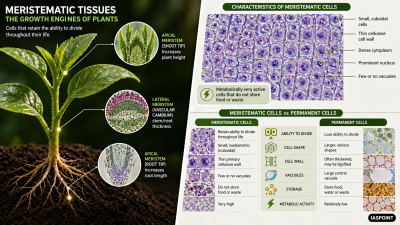
Meristematic tissues are the “growth engines” of the plant. Unlike permanent tissues, these cells retain the ability to divide throughout their life. They are characterized by small, cuboidal cells with thin cellulose walls, dense cytoplasm, a prominent nucleus, and few or no vacuoles. Because they are metabolically very active, they do not store food or waste.
Classification Based on Position
The primary classification of meristems used for UPSC preparation is based on their location within the plant body, which dictates the direction of growth.
1. Apical Meristem
Found at the growing “apices” or tips of the plant, specifically the shoot tips and root tips.
- Function: Responsible for Primary Growth, which increases the length of the plant.
- Key Fact: It produces the primary plant body and is responsible for the plant reaching toward sunlight (shoot) and water (root).
2. Intercalary Meristem
Located at the base of leaves or at the internodes (the regions between two nodes). These are essentially “detached” parts of the apical meristem left behind during growth.
- Function: Facilitates the elongation of the organs. It is particularly important in grasses (monocots).
- Trivia: This tissue allows grass to regrow quickly after being eaten by herbivores or mown by a lawnmower.
3. Lateral Meristem
Occurs along the sides of the stem and roots, running parallel to the long axis.
- Function: Responsible for Secondary Growth, which increases the girth (thickness) of the plant.
- Types:
- Vascular Cambium: Produces secondary xylem and phloem.
- Cork Cambium: Produces the protective outer bark (periderm).
Functional Classification Table
| Type of Meristem | Location | Growth Type | Primary Function |
| Apical | Root and Shoot tips | Primary | Increase in height/length |
| Intercalary | Base of nodes/internodes | Primary | Elongation of twigs/leaves |
| Lateral | Lateral sides of stem/root | Secondary | Increase in diameter/girth |
Classification Based on Origin and Development
For a 360° understanding, meristems are also classified by their developmental history:
- Promeristem (Primordial): The earliest stage of meristematic tissue found in the embryo.
- Primary Meristem: Derived directly from the promeristem; it builds the basic structure of the plant (e.g., Apical and Intercalary).
- Secondary Meristem: Appears later in the life of the plant. It develops from permanent tissues to help in secondary growth (e.g., Cork cambium).
UPSC Prelims Facts and Trivia
- Lack of Vacuoles: Meristematic cells generally lack vacuoles because vacuoles are meant for storage and maintaining turgor, whereas meristematic cells are focused entirely on rapid division.
- Cell Cycle: These cells are always in the state of division (Mitosis) and never enter the G0 (quiescent) phase unless they are differentiating into permanent tissue.
- Regeneration: The presence of meristems is why plants exhibit Indeterminate Growth, meaning they can continue to grow as long as they live, unlike animals which have a fixed growth period.
- Axillary Bud: These are small groups of meristematic cells left behind at the leaf axils by the apical meristem; they have the potential to form a branch or a flower.