

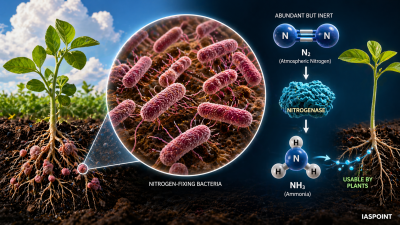
Nitrogen is the most abundant gas in the atmosphere (78%), yet it is chemically inert and cannot be used directly by most living organisms. Nitrogen-fixing bacteria are unique prokaryotes that possess the enzyme Nitrogenase, which enables them to break the triple bond of atmospheric nitrogen (N2) and convert it into ammonia (NH3), a form plants can assimilate.
Classification of Nitrogen-Fixing Bacteria
These bacteria are broadly classified based on their ecological relationship with host plants and their oxygen requirements.
Free-Living (Asymbiotic) Bacteria
These bacteria reside in the soil or water and fix nitrogen independently of a host plant.
- Aerobic (Require Oxygen): Azotobacter and Beijerinckia.
- Anaerobic (No Oxygen): Clostridium pasteurianum and Rhodospirillum.
- Cyanobacteria: Many free-living blue-green algae like Nostoc and Anabaena fix nitrogen in specialized cells called Heterocysts.
Symbiotic Bacteria
These bacteria form a mutualistic relationship with specific plants, exchanging fixed nitrogen for carbohydrates and protection.
- Rhizobium: Found in the root nodules of Leguminous plants (e.g., Pea, Gram, Soyabean).
- Frankia: A non-leguminous nitrogen fixer found in the root nodules of plants like Casuarina and Alnus.
- Anabaena azollae: Resides in the leaf cavities of the water fern Azolla, widely used as a biofertilizer in rice cultivation.
Mechanism of Biological Nitrogen Fixation (BNF)
UPSC Prelims often tests the biochemical requirements and the role of specific proteins in this process.
The Role of Nitrogenase
- Enzyme Complex: Nitrogenase is a Mo-Fe (Molybdenum-Iron) protein.
- Oxygen Sensitivity: Nitrogenase is highly sensitive to molecular oxygen and functions only under anaerobic conditions.
Leghemoglobin (The Oxygen Scavenger)
- In the root nodules of legumes, a pink-colored pigment called Leghemoglobin is present.
- It acts as an “oxygen scavenger,” binding with oxygen to ensure that the interior of the nodule remains anaerobic, thus protecting the Nitrogenase enzyme.
The Nitrogen Cycle: Key Bacterial Players
The conversion of nitrogen involves several distinct steps, each performed by specialized bacteria.
| Step | Process | Key Bacteria Involved |
| Nitrogen Fixation | Atmospheric N2 → Ammonia (NH3) | Rhizobium, Azotobacter, Nostoc |
| Nitrification | Ammonia → Nitrite (NO2^-) | Nitrosomonas, Nitrosococcus |
| Nitrification | Nitrite → Nitrate (NO3^-) | Nitrobacter, Nitrocystis |
| Ammonification | Organic Matter → Ammonia | Bacillus ramosus, Bacillus vulgaris |
| Denitrification | Nitrate → Atmospheric N2 | Pseudomonas denitrificans, Thiobacillus |
Agricultural and Economic Significance
- Biofertilizers: Use of Azotobacter and Rhizobium cultures reduces dependency on chemical nitrogenous fertilizers (like Urea), preventing soil acidification and water pollution.
- Crop Rotation: Leguminous crops are rotated with cereals (like Wheat) to naturally replenish soil nitrogen levels.
- Sustainable Farming: Cyanobacteria like Aulosira are considered the most active nitrogen fixers in Indian rice fields.
Fact-Sheet for UPSC Prelims
- Molybdenum (Mo): It is a crucial micronutrient for nitrogen fixation as it is a core component of the nitrogenase enzyme.
- ATP Requirement: Biological nitrogen fixation is an energy-intensive process; fixing one molecule of N2 requires 16 molecules of ATP.
- Rhizobium Specificity: Rhizobium is host-specific; for example, Rhizobium leguminosarum fixes nitrogen specifically in peas and lentils.
- Nodule Formation: This is a complex interaction involving “Nod factors” secreted by bacteria and flavonoids secreted by plant roots.
- Denitrification Hazard: Denitrifying bacteria like Pseudomonas actually reduce soil fertility by converting useful nitrates back into gaseous nitrogen.