

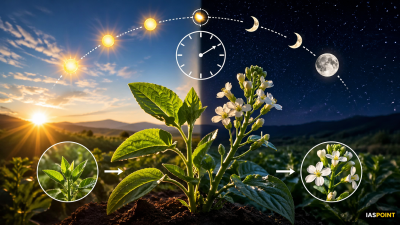
Photoperiodism is the physiological response of plants to the relative lengths of light and dark periods in a 24-hour cycle. It determines the timing of various developmental processes, most notably the transition from vegetative growth to flowering. This phenomenon ensures that plants flower during the season most favorable for pollination and seed set.
Perception of Light Stimulus
- Site of Perception: The light and dark periods are perceived by the leaves.
- Flowering Hormone: A hypothetical flowering hormone called Florigen is synthesized in the leaves and translocated to the shoot apices to induce flowering when the plant is exposed to the required inductive photoperiod.
- Phytochromes: These are specialized blue-green pigment proteins in leaves that act as light receptors. They exist in two interconvertible forms: Pr (red light absorbing) and Pfr (far-red light absorbing). The ratio of these forms triggers the flowering signal.
Classification of Plants Based on Photoperiodism
Plants are categorized based on their “Critical Day Length” (CDL), which is the specific duration of light exposure required to trigger or inhibit flowering.
Short-Day Plants (SDPs)
These plants flower only when the day length is shorter than the critical day length. They actually require a continuous long period of darkness to flower.
- Key Requirement: A long, uninterrupted dark period. If the dark period is interrupted by a brief flash of light, flowering is inhibited.
- Examples: Rice, Soybeans, Tobacco, Chrysanthemum, Coffee.
Long-Day Plants (LDPs)
These plants flower when the day length exceeds the critical day length. They require less darkness and more light.
- Key Requirement: Light periods longer than the CDL.
- Examples: Wheat, Radish, Barley, Sugar beet, Spinach.
Day-Neutral Plants (DNPs)
Flowering in these plants is not regulated by the duration of light or dark periods. They flower after reaching a certain stage of vegetative maturity.
- Examples: Tomato, Cucumber, Cotton, Sunflower, Maize.
Comparison: Light vs. Dark Period Requirements
| Feature | Short-Day Plants (SDPs) | Long-Day Plants (LDPs) |
| Flowering Trigger | Day length < Critical Day Length | Day length > Critical Day Length |
| Critical Factor | Continuous Dark Period (Night) | Light Period (Day) |
| Effect of Light Flash in Dark | Inhibits Flowering | Promotes or has no negative effect |
| Season of Flowering | Late summer or Autumn | Spring or Summer |
Critical Role of the Dark Period
Research indicates that for Short-Day Plants, the duration of the dark period is more critical than the light period. SDPs are often more accurately described as Long-Night Plants. If the long dark period is interrupted by even a few minutes of red light, the plant fails to flower. Conversely, for Long-Day Plants, the dark period must be shorter than a critical maximum.
Interaction with Other Factors
- Interaction with Vernalization: Some plants require a period of cold (vernalization) before they become sensitive to the photoperiod.
- Age of the Plant: Most plants must reach a “ripeness to flower” stage before they can respond to the photoperiodic stimulus.
Practical Applications in Agriculture and Horticulture
- Year-round Production: By controlling artificial light in greenhouses, flowers like Chrysanthemums can be made to bloom throughout the year.
- Crop Zoning: Helps in determining which crops are suitable for specific latitudes where day lengths vary significantly with seasons.
- Hybridization: Synchronizing the flowering times of two different plant varieties by manipulating light to facilitate cross-breeding.
UPSC Prelims Facts & Trivia
- Discovery: Photoperiodism was first discovered by Garner and Allard in 1920 while working with a mutant variety of tobacco called “Maryland Mammoth.”
- Critical Night Length: It is now scientifically established that the “night length” is the decisive factor in flowering, not the “day length.”
- Phytochrome Interconversion: Pr absorbs red light (≈ 660 nm) and converts to Pfr. Pfr absorbs far-red light (≈ 730 nm) and converts back to Pr. Pfr is generally the biologically active form that initiates the flowering response.
- Florigen Mystery: Although “Florigen” was a hypothetical term for decades, recent molecular biology identifies the FT (Flowering Locus T) protein as the mobile signal that travels from leaves to the apex.