

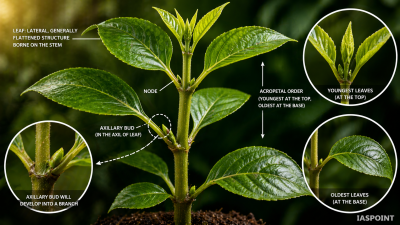
The leaf is a lateral, generally flattened structure borne on the stem. It develops at the node and bears a bud in its axil called the axillary bud, which later develops into a branch. Leaves originate from shoot apical meristems and are arranged in an acropetal order (youngest at the top, oldest at the base).
Structural Components of a Typical Leaf
A complete leaf consists of three main parts: the leaf base, the petiole, and the lamina.
- Leaf Base (Hypopodium): The part by which the leaf is attached to the stem.
- In monocots, the leaf base expands into a sheath covering the stem.
- In some leguminous plants, the leaf base may become swollen, known as the Pulvinus.
- Petiole (Mesopodium): The stalk that connects the lamina to the stem. It helps hold the blade to light and allows the leaf to flutter in the wind, cooling the leaf and bringing fresh air to the surface.
- Lamina or Leaf Blade (Epipodium): The green, expanded part of the leaf with veins and veinlets. The middle prominent vein is called the midrib.
Venation: The Arrangement of Veins
Venation refers to the arrangement of veins and veinlets in the lamina of the leaf. This is a critical diagnostic feature for distinguishing plant classes in UPSC Prelims.
| Venation Type | Description | Occurrence |
| Reticulate | Veins form a network-like pattern. | Characteristic of Dicot plants (e.g., Peepal, Mango, Hibiscus). |
| Parallel | Veins run parallel to each other within the lamina. | Characteristic of Monocot plants (e.g., Grass, Banana, Bamboo, Maize). |
Classification of Leaves: Simple vs. Compound
Leaves are classified based on the level of incision of the lamina.
1. Simple Leaf
A leaf is simple when its lamina is entire or, when incised, the incisions do not touch the midrib (e.g., Mango, Guava).
2. Compound Leaf
When the incisions of the lamina reach the midrib, breaking it into a number of leaflets, it is called a compound leaf.
- Pinnately Compound: Leaflets are present on a common axis called the rachis, which represents the midrib (e.g., Neem).
- Palmately Compound: Leaflets are attached at a common point, i.e., at the tip of the petiole (e.g., Silk cotton).
Phyllotaxy: Arrangement of Leaves on Stem
Phyllotaxy is the pattern of arrangement of leaves on the stem or branch, aimed at avoiding shading of one leaf by another.
- Alternate: A single leaf arises at each node in an alternate manner (e.g., China rose, Mustard, Sunflower).
- Opposite: A pair of leaves arise at each node and lie opposite to each other (e.g., Calotropis, Guava).
- Whorled: More than two leaves arise at a node and form a whorl (e.g., Alstonia, Nerium).
Primary and Secondary Functions of Leaves
Leaves are the primary metabolic laboratories of the plant.
- Photosynthesis: Synthesis of organic food using sunlight, CO2, and water.
- Transpiration: The loss of water vapor from the leaf surface (via stomata), which helps in water ascent and cooling.
- Gaseous Exchange: Stomata facilitate the exchange of O2 and CO2 for respiration and photosynthesis.
- Storage: Fleshy leaves store food and water (e.g., Onion, Aloe vera).
- Protection: Modified into spines to protect against herbivory and reduce water loss (e.g., Cacti).
UPSC Prelims Fact Sheet: Leaf Morphology
- Heterophylly: The presence of more than one type of leaf on the same plant, often an adaptation to environment (e.g., Limnophila has different aerial and submerged leaves).
- Venation Exceptions: Smilax is a monocot with reticulate venation; Calophyllum is a dicot with parallel venation.
- Stomata Location: In dicot leaves (dorsiventral), stomata are usually more numerous on the lower surface; in monocot leaves (isobilateral), they are nearly equal on both sides.
- Insectivorous Leaves: In plants like the Venus Flytrap and Pitcher Plant (Nepenthes), the leaves are modified to catch and digest insects to fulfill nitrogen requirements.