

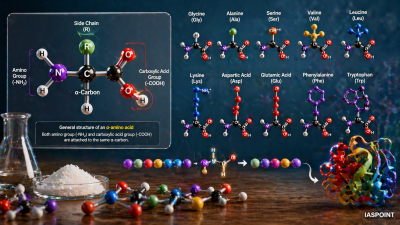
Amino Acids are the organic compounds that serve as the fundamental building blocks of proteins. They are characterized by the presence of both an amino group (-NH2) and a carboxylic acid group (-COOH). In biological systems, these are specifically α-amino acids, meaning both functional groups are attached to the same central carbon atom, known as the α-carbon.
Basic Chemical Structure
The general structure of an amino acid consists of four groups attached to the α-carbon:
- Amino Group (-NH2): The basic functional group.
- Carboxyl Group (-COOH): The acidic functional group.
- Hydrogen Atom (H): A constant component.
- R-group (Side Chain): A variable group that differs for each amino acid, determining its physical and chemical properties (e.g., in Glycine, R is H; in Alanine, R is a methyl group -CH3).
Classification Based on Nutritional Requirement
While there are over 300 amino acids in nature, only 20 are standardly found in proteins. These are classified based on whether the body can synthesize them.
Essential Amino Acids
These cannot be synthesized by the human body and must be supplied through the diet.
- Examples: Phenylalanine, Valine, Threonine, Tryptophan, Isoleucine, Methionine, Histidine, Arginine, Leucine, and Lysine. (Mnemonic: PVT TIM HALL).
Non-Essential Amino Acids
These can be synthesized by the body, primarily in the liver, from other metabolic intermediates.
- Examples: Alanine, Asparagine, Aspartic acid, Glutamic acid, Cysteine, Glycine, Proline, Serine, and Tyrosine.
Classification Based on Chemical Nature of R-Group
The properties of the R-group dictate the behavior of the amino acid in a protein chain.
| Category | Characteristic | Examples |
| Acidic | Contain an extra carboxyl group | Glutamic acid, Aspartic acid |
| Basic | Contain an extra amino group | Lysine, Arginine, Histidine |
| Neutral | Equal number of amino and carboxyl groups | Valine, Alanine, Glycine |
| Aromatic | Contain cyclic ring structures | Tyrosine, Phenylalanine, Tryptophan |
| Sulfur-containing | Contain Sulfur atoms | Cysteine, Methionine |
The Zwitterion Property
Amino acids exhibit a unique ionic behavior in aqueous solutions. Due to the presence of both acidic and basic groups, they can act as “internal salts.”
- At a specific pH called the isoelectric point (pI), the carboxyl group loses a proton (COO^-) and the amino group gains a proton (NH3^+).
- The resulting molecule carries both a positive and negative charge but is electrically neutral overall. This form is called a Zwitterion.
Biological Functions and Importance
- Protein Synthesis: Linked by peptide bonds (amide linkages) to form long polypeptide chains.
- Precursors to Hormones: Tyrosine is a precursor for the hormone Thyroxine and the neurotransmitter Adrenaline (Epinephrine). Tryptophan is a precursor for Vitamin B3 (Niacin) and Serotonin.
- Metabolic Intermediates: Used in the synthesis of glucose (gluconeogenesis) during periods of starvation.
- Buffering Action: Due to their amphoteric nature (acting as both acid and base), amino acids help maintain pH balance in biological fluids.
UPSC Prelims Fact File
- Smallest Amino Acid: Glycine is the simplest and smallest amino acid, where the R-group is a Hydrogen atom. It is the only standard amino acid that is not optically active (achiral).
- Peptide Bond Formation: It is a dehydration synthesis reaction where a water molecule (H2O) is removed during the bond formation between the -COOH of one amino acid and the -NH2 of another.
- Collagen Composition: Glycine and Proline are found in exceptionally high concentrations in collagen, the most abundant protein in animals.
- Selenocysteine: Often referred to as the 21st amino acid, it is found in certain specialized enzymes like glutathione peroxidase.
- Ornithine and Citrulline: These are amino acids that are vital for the Urea Cycle in the liver but are not found in proteins.