

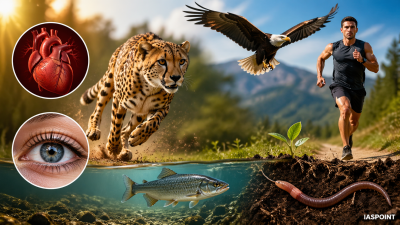
In biological terms, movement is a general characteristic of all living organisms, referring to the displacement of any part of the body. Locomotion is a specific type of movement that results in a change of location or place. While all locomotion is movement, not all movement is locomotion (e.g., the beating of the heart or blinking of eyes).
Types of Movement in Human Cells
The human body exhibits three specialized types of cellular movements which are fundamental to physiological functions.
- Amoeboid Movement: Exhibited by specialized cells like Macrophages and Leukocytes (WBCs) in the blood. It is achieved through pseudopodia formed by the streaming of protoplasm, supported by the cytoskeletal elements like microfilaments.
- Ciliary Movement: Occurs in internal tubular organs lined by ciliated epithelium.
- Trachea: Cilia help in removing dust particles and foreign substances inhaled with air.
- Oviducts (Fallopian Tubes): Ciliary movement facilitates the passage of the ova toward the uterus.
- Muscular Movement: Used for the movement of limbs, jaws, tongue, and for locomotion. This requires the coordinated activity of the Skeletal, Neural, and Muscular systems.
Mechanism of Muscle Contraction: The Sliding Filament Theory
The most accepted model for muscular movement is the Sliding Filament Theory, proposed by Andrew Huxley and Rolf Niedergerke.
The Functional Unit: Sarcomere
The Sarcomere is the basic functional unit of a muscle fiber, located between two Z-lines. It consists of two primary contractile proteins:
- Actin (Thin Filament): Contains binding sites for myosin.
- Myosin (Thick Filament): Contains a head with ATPase activity and binding sites for Actin and ATP.
The Contraction Process
- Neural Signal: A motor neuron sends a signal to the Neuromuscular Junction, releasing Acetylcholine.
- Calcium Release: The signal triggers the release of Calcium ions (Ca2+) from the Sarcoplasmic Reticulum.
- Binding: Calcium binds to Troponin on the actin filament, uncovering the active sites for myosin.
- Cross-Bridge Formation: Myosin heads bind to the exposed active sites on actin using energy from ATP hydrolysis.
- Power Stroke: The myosin heads tilt, pulling the actin filaments toward the center of the sarcomere (M-line), thereby shortening the muscle.
- Relaxation: Ca2+ is pumped back into the sarcoplasmic reticulum, and the muscle returns to its resting state.
Role of the Skeletal System in Locomotion
The skeletal system acts as a system of Levers, while the joints act as Fulcrums.
- Antagonistic Muscle Pairs: Locomotion is usually the result of muscles working in pairs. When one muscle (the Agonist or Prime Mover) contracts, its partner (the Antagonist) relaxes.
- Example: In the movement of the arm, the Biceps (flexor) contracts to bend the elbow, while the Triceps (extensor) relaxes. To straighten the arm, the process reverses.
Red vs. White Muscle Fibers
| Feature | Red Muscle Fibers | White Muscle Fibers |
| Myoglobin Content | High (gives red color). | Low (appears pale/white). |
| Mitochondria | Numerous. | Fewer. |
| Energy Source | Aerobic (Oxygen-dependent). | Anaerobic (Glycolysis). |
| Fatigue | Slow to fatigue; for endurance. | Fast to fatigue; for quick bursts. |
| Example | Flight muscles of birds, human back muscles. | Eyeball muscles, fast-twitch limb muscles. |
Regulation of Movement
- Neural Control: Movement is voluntary and initiated by the Somatic Nervous System.
- Proprioception: Sensory receptors in muscles (Muscle Spindles) and tendons (Golgi Tendon Organs) provide the brain with constant feedback regarding body position and muscle tension.
Disorders Related to Movement
- Myasthenia Gravis: An autoimmune disorder affecting the neuromuscular junction, leading to fatigue and paralysis of skeletal muscles.
- Muscular Dystrophy: A genetic disorder causing progressive degeneration of skeletal muscle.
- Tetany: Rapid spasms in muscle due to low Ca2+ in body fluids.
- Rigormortis: A state of muscle rigidity following death, caused by the depletion of ATP which prevents the detachment of myosin heads from actin.
Key Trivia for Prelims
- Energy Currency: ATP is required both for the contraction (power stroke) and the relaxation (detachment of myosin) of muscles.
- Lactic Acid: During strenuous exercise, anaerobic respiration leads to the accumulation of Lactic Acid, causing muscle fatigue and soreness.
- Largest Muscle: Gluteus maximus (buttock).
- Strongest Muscle: Based on weight, the Masseter (jaw muscle).