

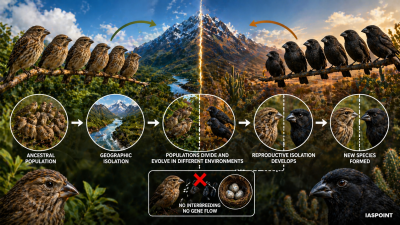
Speciation is the evolutionary process by which populations evolve to become distinct species. A species is defined as a group of individuals that can interbreed to produce fertile offspring. Speciation occurs when a population is divided and reproductive isolation develops, preventing gene flow between the groups.
Mechanism of Speciation
Speciation is not a sudden event (except in certain cases like polyploidy) but a gradual process driven by genetic drift, natural selection, and geographic barriers.
- Genetic Drift: Random changes in allele frequencies, especially in small populations, can lead to the accumulation of unique traits.
- Natural Selection: Different environmental pressures act on isolated populations, favoring different sets of adaptations.
- Reproductive Isolation: The final stage where biological barriers prevent members of two populations from producing viable, fertile offspring.
Types of Speciation
Speciation is categorized based on the geographical relationship between the diverging populations.
| Type | Geographical Context | Mechanism |
| Allopatric | Physical Barrier | Populations are geographically separated (e.g., mountains, oceans). |
| Peripatric | Isolated Niche | A small group breaks off from the main population to a new environment. |
| Parapatric | Adjacent Niche | Populations stay in contact but evolve in different adjacent habitats. |
| Sympatric | Same Location | Evolution of a new species without any physical or geographical barriers. |
Detailed Modes of Speciation
Allopatric Speciation
This is the most common form of speciation. A physical barrier (vicariance) or the migration of a few individuals to a remote area (dispersal) splits a population. Over time, the isolated groups accumulate enough genetic differences that they can no longer interbreed even if they meet again.
- Example: Darwin’s Finches in the Galápagos Islands evolved into different species based on the specific food sources available on different islands.
Sympatric Speciation
This occurs while the populations inhabit the same geographic area. It is more common in plants than animals.
- Polyploidy: A condition where an organism has more than two complete sets of chromosomes. This often occurs due to accidents during cell division, immediately creating a new species that cannot breed with its diploid parents.
- Sexual Selection: In some fish species (like Cichlids in African lakes), females may choose mates based on specific colors, eventually splitting the population into distinct species based on preference.
Reproductive Isolation Mechanisms
Reproductive isolation is essential to maintain the integrity of a species. It is divided into two broad categories:
1. Pre-zygotic Isolation (Before Fertilization)
- Temporal Isolation: Species breed at different times (seasons, times of day).
- Behavioral Isolation: Different courtship rituals or signals (e.g., specific bird songs).
- Mechanical Isolation: Structural differences in reproductive organs prevent successful mating.
- Ecological Isolation: Species occupy different habitats in the same area.
2. Post-zygotic Isolation (After Fertilization)
- Hybrid Inviability: The hybrid zygote fails to develop or reach sexual maturity.
- Hybrid Sterility: The hybrid is healthy but cannot produce offspring (e.g., Mules, the offspring of a male donkey and a female horse).
- Hybrid Breakdown: First-generation hybrids are fertile, but their offspring (F2) are weak or sterile.
Evolutionary Concepts Related to Speciation
- Adaptive Radiation: The rapid evolution of many species from a single common ancestor when introduced to a variety of new environmental opportunities (e.g., Australian Marsupials).
- Gradualism: The theory that speciation occurs through the slow and steady accumulation of small changes over long periods (Darwin’s view).
- Punctuated Equilibrium: Proposed by Eldredge and Gould, this theory suggests that species remain stable for long periods, “punctuated” by brief periods of rapid change and speciation.
Important Trivia for UPSC Prelims
- The Biological Species Concept: Proposed by Ernst Mayr; it defines species based on reproductive isolation.
- Founder Effect: When a new population is started by a few members of an original population, the reduced genetic diversity can lead to rapid speciation (a subset of peripatric speciation).
- Ring Species: A connected series of neighboring populations, each of which can interbreed with neighbors, but for which there exist at least two “end” populations in the series which are too distantly related to interbreed.
- Sibling Species: Species that are morphologically nearly identical but are reproductively isolated (e.g., Drosophila pseudoobscura and Drosophila persimilis).