

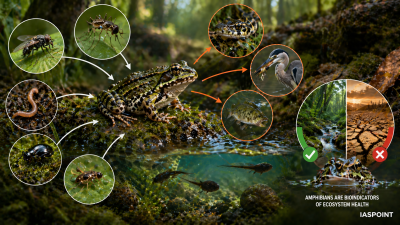
Amphibians occupy a unique ecological position as “mid-level” consumers, acting as both predators of invertebrates and prey for larger vertebrates. Their survival is intricately tied to the availability of moisture, making them critical indicators of ecosystem health.
1. Diverse Habitats and Distribution
Amphibians are found across the globe, except in Antarctica and some remote oceanic islands. Their habitat choice is primarily dictated by the need for moisture to prevent desiccation.
- Aquatic Habitats: Many species spend their entire lives in freshwater (ponds, lakes, streams). Examples include the African Clawed Frog and many species of newts.
- Terrestrial Habitats: While they live on land, they are restricted to damp environments like leaf litter, rotting logs, or burrows.
- Arboreal Habitats: Tree frogs possess specialized toe pads to live in the forest canopy, often using water collected in bromeliads (plants) for breeding.
- Fossorial Habitats: Caecilians and certain toads (like the Indian Purple Frog) are adapted for a subterranean life, emerging only during heavy rains.
2. Feeding Ecology and Diet
Amphibians undergo a significant dietary shift during their life cycle, which reduces competition between adults and larvae.
- Larval Stage: Most tadpoles are herbivorous or detritivores, feeding on algae and organic debris. Some, however, are carnivorous or even cannibalistic if food is scarce.
- Adult Stage: Virtually all adult amphibians are carnivorous. They feed on insects, spiders, worms, and occasionally small vertebrates like mice or other frogs.
- Feeding Mechanism: They are “sit-and-wait” predators. They use their sticky, bifid tongues to capture prey with high-speed precision.
3. Amphibians as Bio-indicators
Amphibians are often described as “Ecological Sentinels” or bio-indicators for several reasons:
- Biphasic Life: They are exposed to both aquatic pollutants (during the larval stage) and terrestrial pollutants/atmospheric changes (as adults).
- Permeable Skin: Their skin easily absorbs toxic chemicals, heavy metals, and radiation, making them the first to react to environmental degradation.
- Sensitivity to Climate: Changes in temperature and rainfall patterns immediately impact their breeding cycles and hibernation.
4. Survival Strategies: Hibernation and Aestivation
To cope with unfavorable environmental conditions, amphibians enter states of metabolic depression.
| Strategy | Season | Process |
| Hibernation | Winter | Animals bury themselves in mud at the bottom of ponds or in deep burrows to survive freezing temperatures. |
| Aestivation | Summer | Animals retreat underground and may secrete a mucous cocoon to prevent water loss during droughts. |
5. Defense Mechanisms in the Wild
To compensate for their soft bodies, amphibians have evolved various defense strategies:
- Aposematic Coloration: Bright “warning” colors (red, orange, yellow) signaling toxicity to predators.
- Crypsis (Camouflage): Blending into the background (e.g., Mossy Frogs).
- Thanatosis: “Playing dead” to discourage predators that prefer live prey.
- Chemical Defense: Secretion of alkaloids or milky toxins from parotoid glands.
6. Threats and Global Declines
The “Amphibian Crisis” is a major topic in conservation biology.
- Chytridiomycosis: A disease caused by the Batrachochytrium dendrobatidis fungus that thickens their skin, leading to heart failure because they cannot breathe or regulate electrolytes.
- Habitat Fragmentation: Draining of wetlands for agriculture and urban development.
- UV Radiation: Increased UV-B radiation due to ozone depletion damages amphibian eggs and causes mutations.
- Over-exploitation: Use in the pet trade, traditional medicine, and as a food source (frog legs).
UPSC Prelims Trivia: Ecology
- The Wallace Line: A faunal boundary line that separates the ecozones of Asia and Wallacea. Amphibian distribution changes significantly across this line.
- Living Fossils: The Purple Frog (Nasikabatrachus sahyadrensis) of the Western Ghats is a relict of a lineage that lived alongside dinosaurs.
- Acid Rain Sensitivity: Amphibian embryos are highly sensitive to pH changes; acidic water (pH < 5) often leads to total reproductive failure in pond-breeding species.