

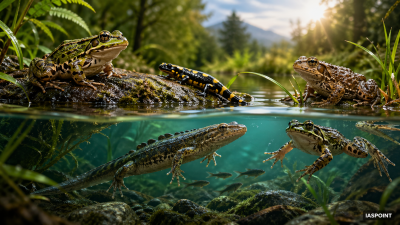
Amphibians are ectothermic (cold-blooded) vertebrates belonging to the Class Amphibia within the Superclass Tetrapoda. They represent an evolutionary bridge between aquatic fish and terrestrial reptiles. The term is derived from the Greek word amphibios, meaning “double life,” reflecting their existence in both water and on land.
Key Anatomical and Physiological Characteristics
Skin and Respiration
- Permeable Skin: Amphibians possess moist, glandular skin lacking scales, hair, or feathers. This skin plays a critical role in cutaneous respiration, allowing the exchange of oxygen and carbon dioxide directly with the environment.
- Mucous Glands: Specialized glands secrete mucus to keep the skin moist, which is essential for oxygen absorption.
- Respiratory Transitions: Most species utilize gills during their larval stage and develop lungs as adults, though many continue to rely heavily on skin and the buccal cavity for gas exchange.
Circulatory and Nervous Systems
- Three-Chambered Heart: The circulatory system consists of two atria and one ventricle. This results in some mixing of oxygenated and deoxygenated blood, which is less efficient than the four-chambered hearts of birds and mammals.
- Ectothermy: They cannot regulate internal body temperature and depend on external heat sources.
- Sensory Organs: Most amphibians possess a tympanum (eardrum) for hearing and a well-developed visual system adapted for low-light environments.
The Three Living Orders of Amphibia
| Order | Common Name | Key Characteristics | Examples |
| Anura | Frogs and Toads | Tail-less adults, long hind limbs for jumping, external fertilization. | Indian Bullfrog, Cane Toad |
| Caudata (Urodela) | Salamanders and Newts | Retain tails as adults, elongated bodies, usually internal fertilization. | Axolotl, Fire Salamander |
| Gymnophiona (Apoda) | Caecilians | Limbless, serpentine bodies, often blind, mostly fossorial (burrowing). | Ichthyophis (Indian Caecilian) |
Life Cycle and Metamorphosis
The life cycle typically involves Indirect Development, characterized by distinct stages:
- Egg: Usually laid in water or moist environments as they lack a protective shell (anamniotic eggs).
- Larva (Tadpole): Fully aquatic, possessing gills and a lateral line system similar to fish.
- Metamorphosis: A biological process involving the shrinkage of the tail (in anurans), growth of limbs, and replacement of gills with lungs.
- Adult: Transition to a terrestrial or semi-aquatic lifestyle.
Ecological Significance and UPSC Prelims Facts
Bio-indicators of Environmental Health
Due to their permeable skin and dual life cycle, amphibians are highly sensitive to environmental changes. They are considered “canaries in the coal mine” for ecosystems, indicating shifts in water quality, UV radiation, and chemical pollution.
Defense Mechanisms
- Granular Glands: Many species possess glands that secrete toxins (parotoid glands in toads).
- Aposematism: Bright coloration (e.g., Poison Dart Frogs) serves as a warning to predators regarding their toxicity.
- Batesian Mimicry: Non-toxic species sometimes evolve to look like toxic ones for protection.
Notable Indian Amphibians
- Purple Frog (Nasikabatrachus sahyadrensis): Endemic to the Western Ghats; often referred to as a “living fossil” because it diverged from other frogs millions of years ago.
- Himalayan Newt (Tylototriton verrucosus): The only species of salamander found in India, restricted to the Eastern Himalayas.
- Malabar Gliding Frog: Known for the expanded webbing between its toes that allows it to glide between trees.
Comparison: Frogs vs. Toads
| Feature | Frogs | Toads |
| Skin Texture | Smooth, moist, and slimy. | Warty, dry, and bumpy. |
| Habitat | Mostly near or in water. | More terrestrial, can live in drier areas. |
| Hind Limbs | Long, powerful for jumping. | Shorter, preferred for walking or small hops. |
| Teeth | Usually have vomerine teeth in the upper jaw. | No teeth. |
Threats and Conservation Status
Amphibians are currently the most threatened vertebrate group globally.
- Chytrid Fungus (Batrachochytrium dendrobatidis): A devastating fungal disease causing mass die-offs globally.
- Habitat Fragmentation: Loss of wetlands and deforestation in biodiversity hotspots like the Western Ghats.
- Climate Change: Rising temperatures lead to the drying of breeding pools and disruption of hibernation cycles.
- Conservation Status: Many Indian species are listed as Critically Endangered or Endangered under the IUCN Red List and are protected under the Wildlife (Protection) Act, 1972.