

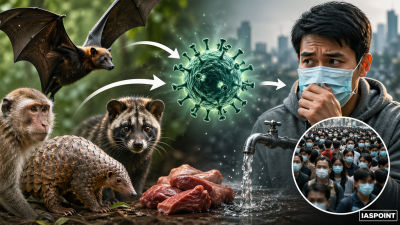
Zoonoses are infectious diseases that have jumped from a non-human animal to humans. Zoonotic pathogens may be bacterial, viral, or parasitic, and they spread to humans through direct contact or through food, water, and the environment. According to the WHO, approximately 60% of all emerging infectious diseases in humans are zoonotic in nature.
Classification by Pathogen Type
Zoonotic diseases are often classified by the type of microorganism involved. The following table highlights the most significant zoonoses for the UPSC Prelims.
| Disease | Pathogen Type | Animal Reservoir/Source |
| Rabies | Virus (Lyssavirus) | Dogs, Bats, Monkeys |
| Nipah | Virus (Henipavirus) | Fruit Bats (Pteropus) |
| Anthrax | Bacteria (Bacillus anthracis) | Cattle, Sheep, Goats |
| Brucellosis | Bacteria (Brucella spp.) | Livestock (unpasteurized milk) |
| Toxoplasmosis | Protozoa (Toxoplasma gondii) | Cats (feces), Undercooked meat |
| Bovine TB | Bacteria (M. bovis) | Cattle |
| Glanders | Bacteria (B. mallei) | Horses, Mules, Donkeys |
| Ebola | Virus (Filoviridae) | Fruit Bats, Primates |
Significant Viral Zoonoses
Rabies
Rabies is a 100% vaccine-preventable viral disease. It is almost always fatal once clinical symptoms appear.
- Transmission: Through the saliva of infected animals via bites or scratches.
- Symptoms: Hydrophobia (fear of water), Photophobia, and Aerophobia.
- India Context: India accounts for a significant percentage of global rabies deaths. The National One Health Programme for Prevention and Control of Rabies aims for “Zero human death due to dog-mediated Rabies by 2030.”
Nipah Virus (NiV)
- Natural Host: Fruit bats of the Pteropus genus.
- Transmission: Consumption of fruits contaminated by bat saliva or urine, or raw date palm sap.
- Clinical Features: Ranges from asymptomatic infection to acute respiratory infection and fatal encephalitis. It has seen recurring outbreaks in Kerala, India.
Avian and Swine Influenza
- H5N1 (Bird Flu): Highly pathogenic avian influenza; primarily affects birds but can infect humans in close contact.
- H1N1 (Swine Flu): A respiratory disease of pigs caused by type A influenza viruses. The 2009 pandemic was caused by a quadruple-reassortant strain.
Significant Bacterial Zoonoses
Anthrax
- Nature: A serious infectious disease caused by gram-positive, rod-shaped bacteria.
- Transmission: Handling products from infected animals or breathing in anthrax spores. It is notably used as a potential biological warfare agent due to its hardy spores.
Brucellosis
- Transmission: Primarily through the consumption of unpasteurized dairy products or direct contact with infected animal fluids.
- Symptoms: Known as “Undulant Fever” because the fever typically rises and falls.
The “One Health” Approach
The “One Health” concept is a collaborative, multisectoral, and transdisciplinary approach—working at the local, regional, national, and global levels—with the goal of achieving optimal health outcomes recognizing the interconnection between people, animals, plants, and their shared environment.
National Mission on One Health
India has established the National Institute of One Health in Nagpur. The mission focuses on:
- Integrated surveillance of zoonotic diseases.
- Strengthening the coordination between the Ministry of Health and Family Welfare and the Ministry of Fisheries, Animal Husbandry, and Dairying.
Factors Increasing Zoonotic Spillovers
- Deforestation and Land Use Change: Encroachment into wildlife habitats increases human-animal interaction.
- Illegal Wildlife Trade: Markets selling “bushmeat” or exotic animals act as “melting pots” for pathogens.
- Climate Change: Shifting temperatures alter the geographic range of animal hosts and vectors.
- Intensive Livestock Farming: High-density animal rearing can facilitate the rapid spread of mutations in pathogens.
Key Facts for UPSC Prelims
- Reverse Zoonosis (Anthroponosis): A disease that is transmitted from humans to animals (e.g., humans passing COVID-19 to zoo lions).
- Kyasanur Forest Disease (KFD): While also a vector-borne disease (tick-borne), it is fundamentally zoonotic as it circulates in monkeys before spilling over to humans.
- Eradication vs. Elimination: No zoonotic disease has been globally eradicated because the animal reservoir cannot be completely eliminated. Smallpox could be eradicated only because it had no animal reservoir.
- Zoonotic spillover: The moment when a pathogen passes from a member of one species to another species.