

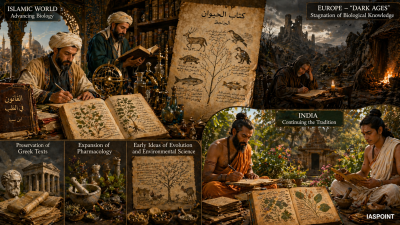
During the Medieval period (roughly 5th to 15th century), biological advancement shifted from Europe—which entered the “Dark Ages”—to the Islamic World and continued in India. This era was characterized by the preservation of Greek texts, the expansion of pharmacology, and the first hints of evolutionary theory and environmental science.
The Islamic Golden Age: The Bridge to Modern Biology
Islamic scholars translated Greek works into Arabic and added original empirical observations, particularly in zoology and human physiology.
Al-Jahiz (776–868 CE) and the “Book of Animals”
- Kitab al-Hayawan: Al-Jahiz authored this monumental work, which described over 350 animal species.
- Early Evolutionary Thoughts: He was the first to describe the “Struggle for Existence.” He noted that environmental factors influence animals to develop new characteristics to ensure survival, a precursor to the theory of natural selection.
- Food Chains: He described the concept of food chains and the biological interdependence of species.
Ibn al-Baitar (1197–1248 CE): The Great Botanist
- Kitab al-Jami: This text was an encyclopedia of botany and pharmacology, listing over 1,400 plants, foods, and drugs.
- Pharmacognosy: He contributed significantly to the study of medicinal plants, identifying their curative properties and geographical distribution.
Ibn al-Nafis (1213–1288 CE) and Pulmonary Circulation
- Discovery: He was the first to describe the pulmonary circulation of blood. He challenged Galen’s long-held view that blood passed between the heart’s ventricles through invisible pores.
- Mechanism: He correctly identified that blood flows from the right ventricle to the lungs through the pulmonary artery, mixes with air, and returns to the left ventricle.
Medieval Indian Contributions: Post-Gupta Era
Biology in medieval India focused heavily on agriculture, veterinary science, and the refinement of Ayurvedic surgery.
Vrkshayurveda (The Science of Plant Life)
- Surapala (c. 10th Century): Author of a major version of Vrkshayurveda. He discussed plant diseases, soil selection, and the use of fertilizers.
- Plant Pathology: The text categorized plant diseases into internal (physiological) and external (parasitic/environmental) factors.
Shalihotra Samhita (Veterinary Science)
- Horse Care: Shalihotra is considered the founder of veterinary sciences in India. His work focused on the anatomy, breeds, and diseases of horses (Asvayurveda).
- Elephantology: Similar texts like Hastyayurveda by Palakapya focused on the anatomy and health of elephants, which were crucial for medieval warfare and transport.
The European Medieval Period and the Rise of Universities
While scientific growth was slower in Europe, the establishment of universities led to a slow revival of natural history.
Albertus Magnus (c. 1200–1280 CE)
- Doctor Universalis: He was a Dominican friar who championed the study of nature as a legitimate scientific endeavor.
- De Vegetabilibus: His botanical work provided detailed descriptions of plant morphology, distinguishing between monocotyledons and dicotyledons based on leaf structure.
- Field Observation: Unlike many of his contemporaries who relied on books, Magnus insisted on personal observation and experimentation.
Key Medieval Biologists and Discoveries
| Scholar | Region | Key Work | Major Contribution |
| Al-Razi (Rhazes) | Persia | Kitab al-Hawi | Distinguished between Smallpox and Measles; used animal testing for drugs. |
| Ibn Sina (Avicenna) | Persia | The Canon of Medicine | Introduced clinical trials and recognized the contagious nature of infectious diseases. |
| Ibn al-Awwam | Al-Andalus | Kitab al-Filaha | Advanced medieval agriculture, discussing 585 different plants and techniques. |
| Madhava Kara | India | Rug-vinishcaya | A key diagnostic text in Ayurveda focusing on the pathology of various diseases. |
Medieval Innovations in Biological Understanding
- The Microscope Forerunners: While the microscope was not invented until the Renaissance, the study of optics by Ibn al-Haytham (Alhazen) provided the theoretical foundation for magnification.
- Hospitals (Bimaristans): The medieval Islamic world established the first teaching hospitals where biological theory was applied to clinical practice, including anatomical studies.
- Forestry and Conservation: Medieval Indian kings like Firoz Shah Tughlaq established extensive fruit orchards and documented tree-planting techniques, contributing to horticultural biology.
UPSC Prelims Fact File: Medieval Biology
- Zoonosis: Medieval scholars were among the first to notice that certain diseases could jump from animals to humans, particularly in the context of rabies.
- Alchemy to Chemistry: The transition from alchemy to chemistry during this period allowed for the extraction of plant alkaloids, which improved the efficacy of biological medicines.
- The Black Death (1347): This pandemic led to early biological observations regarding quarantine and the realization that diseases could be transmitted through vectors like fleas and rats, though the exact germ theory was not yet understood.