

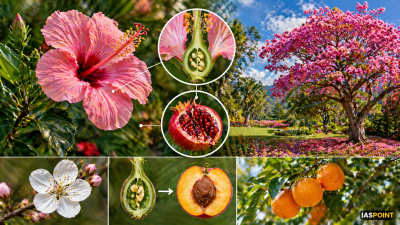
Angiosperms, commonly known as flowering plants, constitute the most diverse group within the kingdom Plantae. Representing approximately 80% of all known living plant species, they are vascular seed plants where the ovules are enclosed within an ovary, which later develops into a fruit. This distinguishes them from Gymnosperms (naked seeds).
Key Morphological and Biological Features
- Presence of Flowers: The flower serves as the reproductive unit, facilitating more efficient pollination through various agents like wind, water, and animals.
- Enclosed Seeds: Unlike gymnosperms, the seeds develop inside the ovary. Post-fertilization, the ovary matures into a fruit.
- Double Fertilization: A unique characteristic of angiosperms where one male gamete fuses with the egg (syngamy) to form a zygote, and the second male gamete fuses with two polar nuclei to form the triploid Primary Endosperm Nucleus (PEN).
- Vascular System Complexity: They possess well-developed xylem (containing vessels, tracheids, fibers, and parenchyma) and phloem (containing sieve tubes and companion cells).
- Triploid Endosperm: The endosperm, which provides nutrition to the developing embryo, is formed after fertilization and is typically triploid (3n).
Classification: Monocotyledons vs. Dicotyledons
Angiosperms are traditionally divided into two primary classes based on the number of embryonic leaves (cotyledons) present in the seed.
| Feature | Monocotyledons (Monocots) | Dicotyledons (Dicots) |
| Cotyledons | Single cotyledon in the seed | Two cotyledons in the seed |
| Venation | Parallel venation in leaves | Reticulate (net-like) venation |
| Root System | Fibrous root system | Taproot system |
| Vascular Bundles | Scattered throughout the stem | Arranged in a ring-like pattern |
| Floral Parts | Multiples of three (Trimerous) | Multiples of four or five (Tetramerous/Pentamerous) |
| Secondary Growth | Absent (usually) | Present (in woody plants) |
| Examples | Wheat, Maize, Bamboo, Rice, Lilies | Gram, Pea, Mango, Mustard, Sunflower |
Reproductive Mechanisms in Angiosperms
The life cycle involves an alternation of generations between the dominant diploid sporophyte and the reduced haploid gametophyte.
Microsporogenesis and Megasporogenesis
- Microsporogenesis: Occurs in the anther (stamen), leading to the formation of pollen grains (male gametophytes).
- Megasporogenesis: Occurs in the ovule (pistil/carpel), leading to the formation of the embryo sac (female gametophyte).
- Pollination Types: Includes Autogamy (self-pollination in the same flower), Geitonogamy (different flower, same plant), and Xenogamy (different plant).
Ecological and Economic Importance
- Food Security: Major cereal crops (Rice, Wheat, Maize) and pulses are angiosperms.
- Medicinal Value: Sources of alkaloids and compounds; for example, Cinchona (Quinine) and Papaver somniferum (Morphine).
- Industrial Raw Materials: Provide timber, fibers (Cotton, Jute), oils, and rubber.
- Oxygen Production: Significant contributors to terrestrial oxygen through photosynthesis.
Facts and Trivia for UPSC Prelims
- Smallest Angiosperm: Wolffia (watermeal), which is nearly microscopic.
- Largest Angiosperm: Eucalyptus regnans, which can reach heights over 90 meters.
- Oldest Living Angiosperm Lineage: Amborella trichopoda, found only in New Caledonia, is considered the most basal extant angiosperm.
- Rafflesia arnoldii: Produces the world’s largest individual flower and is a parasitic angiosperm.
- Saffron: Derived from the dried stigma of Crocus sativus, a monocotyledonous flowering plant.
- Hydrophily: Pollination by water, seen in plants like Vallisneria and Hydrilla.
Adaptive Radiation and Dominance
Angiosperms appeared during the early Cretaceous period (approx. 130 million years ago). Their dominance over gymnosperms is attributed to:
- Shorter Life Cycles: Allowing for rapid colonization and evolution.
- Animal Co-evolution: Developing specialized floral structures to attract specific pollinators, increasing fertilization success.
- Fruit Dispersal: Protecting seeds and utilizing animals for wide-range dispersal via ingestion or adhesion.