

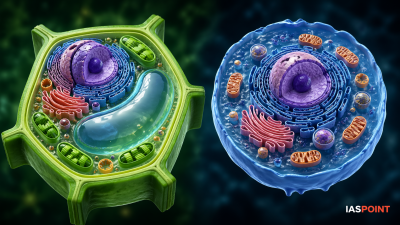
While both plant and animal cells are eukaryotic and share fundamental organelles like the nucleus, mitochondria, and endoplasmic reticulum, they exhibit distinct structural differences necessitated by their varying modes of life—autotrophic (producers) versus heterotrophic (consumers).
Core Structural Components
Plant cells are generally larger and have a fixed, rectangular shape due to the presence of a rigid cell wall. Animal cells are usually smaller, irregular, or round, as they lack a cell wall, allowing for greater flexibility and mobility.
Comparative Analysis: Plant Cell vs. Animal Cell
| Feature | Plant Cell | Animal Cell |
| Cell Wall | Present; composed of cellulose. | Absent; only plasma membrane exists. |
| Shape | Fixed, rectangular, or cubic. | Irregular or round; flexible. |
| Vacuole | One large central vacuole (occupies 90% volume). | One or more small, temporary vacuoles. |
| Plastids | Present (Chloroplasts, Chromoplasts, Leucoplasts). | Absent. |
| Centrioles | Usually absent (except in lower plant forms). | Present; crucial for cell division. |
| Lysosomes | Rarely present; vacuoles perform waste disposal. | Present; contain digestive enzymes. |
| Storage Material | Starch. | Glycogen. |
| Cilia | Very rare. | Present in many types (e.g., respiratory tract). |
Key Organelles and Their Functions
1. The Cell Wall and Plasma Membrane
- Plant Cell Wall: Provides mechanical strength and protection. It is a non-living layer made of Cellulose, hemicellulose, and pectin.
- Plasma Membrane: Present in both; it is a selectively permeable lipid bilayer that regulates the entry and exit of molecules.
2. Plastids (Exclusive to Plants)
- Chloroplasts: Contain chlorophyll for photosynthesis.
- Chromoplasts: Contain pigments (carotenoids) giving color to flowers and fruits.
- Leucoplasts: Colorless plastids used for storing starch (Amyloplasts), oils (Elaioplasts), or proteins (Aleuroplasts).
3. Vacuoles
- In plants, the large central vacuole maintains Turgor Pressure, which keeps the plant upright. It stores cell sap, waste products, and nutrients.
- In animals, vacuoles are primarily used for endocytosis and exocytosis (transport).
4. Centrioles and Centrosomes
- Animal cells possess a centrosome containing two centrioles that organize microtubule assembly during cell division (spindle fiber formation). Most higher plants achieve division without centrioles.
Functional Differences for UPSC Prelims
- Cytokinesis: During cell division, plant cells form a Cell Plate in the center that grows outward. Animal cells undergo “furrowing” or cleavage, where the cell membrane pinches inward.
- Metabolism: Plant cells can synthesize all necessary amino acids and vitamins. Animal cells must obtain “essential” amino acids and vitamins through their diet.
- Osmotic Regulation: The cell wall prevents plant cells from bursting (lysis) when placed in a hypotonic solution (high water concentration), whereas animal cells may burst due to the lack of a wall.
Facts and Trivia for UPSC
- The Largest Plant Cell: Acetabularia (a giant unicellular green alga) can grow up to 10 cm in length.
- Plasmodesmata: These are microscopic channels that traverse the cell walls of plant cells, enabling transport and communication between them—a feature absent in animal cells.
- Glyoxysomes: Specialized peroxisomes found in germinating seeds that convert stored lipids into carbohydrates; these are generally absent in animal cells.
- Tonoplast: The specific name for the membrane surrounding the large central vacuole in a plant cell.
Summary of Shared Features
Both cells contain:
- Nucleus: Repository of genetic information.
- Mitochondria: Site of aerobic respiration (ATP production).
- Endoplasmic Reticulum: Protein and lipid synthesis.
- Golgi Apparatus: Packaging and secretion (often called Dictyosomes in plants).
- Cytoplasm: The jelly-like matrix where metabolic reactions occur.