

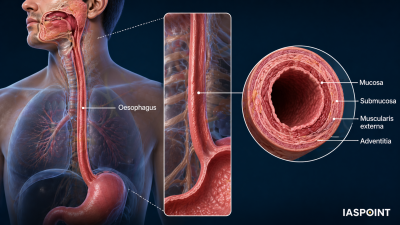
The oesophagus, or food pipe, is a thin, long muscular tube approximately 25 cm in length. It serves as a vital conduit connecting the pharynx to the stomach. Unlike other parts of the alimentary canal, the oesophagus does not produce digestive enzymes or perform any chemical digestion.
Anatomical Path and Structure
- Location: It passes posteriorly through the neck, thorax, and pierces the diaphragm to enter the abdominal cavity.
- Tissue Composition: * The upper one-third is composed of skeletal muscle (voluntary control).
- The middle one-third is a mix of skeletal and smooth muscle.
- The lower one-third is composed entirely of smooth muscle (involuntary control).
- Mucosal Lining: It is lined with non-keratinized stratified squamous epithelium, which provides protection against abrasion from swallowed food.
Mechanism of Food Movement
- Peristalsis: The movement of food through the oesophagus is achieved by a series of wave-like muscular contractions and relaxations called peristalsis. This process is involuntary and ensures that food moves toward the stomach regardless of gravity.
- Bolus: The masticated food, mixed with saliva in the mouth, is converted into a lubricated mass known as a bolus before entering the oesophagus.
- Mucus Secretion: While it lacks digestive glands, the oesophagus contains many mucous glands that secrete mucus to lubricate the passage for the bolus.
Physiological Sphincters
The flow of material through the oesophagus is regulated by two primary sphincters:
- Upper Oesophageal Sphincter (UES): Located at the junction of the pharynx and oesophagus; it prevents air from entering the gastrointestinal tract.
- Gastro-oesophageal (Cardiac) Sphincter: A muscular valve located at the opening of the oesophagus into the stomach. It regulates the entry of food into the stomach and, more importantly, prevents the backflow (reflux) of highly acidic gastric juice into the oesophagus.
Comparison: Oesophagus vs. Trachea
| Feature | Oesophagus (Food Pipe) | Trachea (Windpipe) |
|---|---|---|
| Position | Posterior (Behind the trachea) | Anterior (In front of the oesophagus) |
| Function | Transport of food/bolus | Transport of air |
| Structure | Collapsible muscular tube | Non-collapsible tube held by C-shaped cartilaginous rings |
| Protection | Guarded by the Epiglottis during swallowing | Guarded by the Glottis |
UPSC Prelims Fact File
- Absence of Digestion: The oesophagus is the only part of the alimentary canal where no chemical digestion of food occurs.
- Deglutition: This is the scientific term for the act of swallowing, involving coordinated action of the tongue, soft palate, pharynx, and oesophagus.
- GERD (Gastroesophageal Reflux Disease): A clinical condition where the gastro-oesophageal sphincter fails to close properly, allowing stomach acid to irritate the oesophageal lining (commonly known as heartburn).
- Barrett’s Oesophagus: A condition where the normal squamous epithelium of the oesophagus is replaced by columnar epithelium due to chronic acid reflux; a significant topic in health-related current affairs.
- Diaphragmatic Hiatus: The specific opening in the diaphragm through which the oesophagus passes. A “Hiatal Hernia” occurs when a part of the stomach pushes up through this opening.