

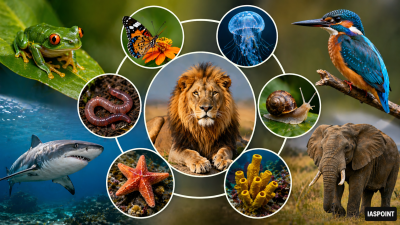
The Kingdom Animalia comprises multicellular, eukaryotic organisms. To categorize the vast diversity of life, biologists use specific fundamental features as the basis for classification.
Levels of Organization
Animals exhibit varying degrees of complexity in their cellular arrangement.
- Cellular Level: Cells are arranged as loose aggregates. Division of labor occurs among cells, but they do not form tissues. (Example: Porifera)
- Tissue Level: Cells performing the same function are arranged into tissues. (Example: Coelenterata and Ctenophora)
- Organ Level: Tissues are grouped together to form organs, each specialized for a particular function. (Example: Platyhelminthes)
- Organ System Level: Organs associate to form functional systems like digestive or circulatory systems. (Example: Annelids, Arthropods, Molluscs, Echinoderms, and Chordates)
Body Symmetry
Symmetry describes how the body parts are arranged around a central axis.
- Asymmetry: The body cannot be divided into two equal halves through any plane passing through the center. (Example: Most Sponges)
- Radial Symmetry: Any plane passing through the central axis of the body divides the organism into two identical halves. (Example: Coelenterates, Ctenophores, and adult Echinoderms)
- Bilateral Symmetry: The body can be divided into identical left and right halves in only one plane. (Example: Annelids, Arthropods, and Chordates)
Germinal Layers (Embryonic Organization)
The number of layers formed during embryonic development determines the complexity of the organism’s body plan.
- Diploblastic: Animals in which the cells are arranged in two embryonic layers: an external ectoderm and an internal endoderm, separated by an undifferentiated layer called mesoglea. (Example: Coelenterates)
- Triploblastic: Animals in which the developing embryo has a third germinal layer, the mesoderm, between the ectoderm and endoderm. (Example: Platyhelminthes to Chordates)
Coelom (Body Cavity)
The presence or absence of a cavity between the body wall and the gut wall is a primary classification criterion.
- Acoelomates: Animals in which the body cavity is absent. (Example: Platyhelminthes)
- Pseudocoelomates: The body cavity is not lined by mesoderm; instead, the mesoderm is present as scattered pouches between the ectoderm and endoderm. (Example: Aschelminthes/Roundworms)
- Coelomates: Animals possessing a true coelom lined by mesoderm. (Example: Annelids, Molluscs, Arthropods, Echinoderms, Hemichordates, and Chordates)
Segmentation and Notochord
These structural features define higher levels of biological complexity.
- Metamerism: In some animals, the body is externally and internally divided into segments with a serial repetition of at least some organs. This is seen in Annelids (e.g., Earthworms).
- Notochord: A mesodermally derived rod-like structure formed on the dorsal side during embryonic development.
- Chordates: Possess a notochord at some stage of life.
- Non-chordates: Organisms without a notochord (Porifera to Echinoderms).
Comparative Summary of Classification Criteria
| Feature | Porifera | Coelenterata | Platyhelminthes | Aschelminthes | Annelida | Chordata |
| Level of Org. | Cellular | Tissue | Organ | Organ-system | Organ-system | Organ-system |
| Symmetry | Various | Radial | Bilateral | Bilateral | Bilateral | Bilateral |
| Coelom | Absent | Absent | Absent | Pseudo | Present | Present |
| Segmentation | Absent | Absent | Absent | Absent | Present | Present |
| Digestive Sys. | Absent | Incomplete | Incomplete | Complete | Complete | Complete |
Key Facts for UPSC Prelims
- Open vs. Closed Circulatory System: In an open system (Arthropods, Molluscs), blood is pumped into body cavities. In a closed system (Annelids, Chordates), blood circulates through a series of vessels.
- Incomplete Digestive System: A system with a single opening that serves as both mouth and anus, found in Coelenterates and Platyhelminthes.
- Echinoderm Symmetry Paradox: Adult Echinoderms exhibit radial symmetry, but their larvae exhibit bilateral symmetry—an evolutionary trait often questioned in competitive exams.
- Triploblastic Acoelomates: Platyhelminthes are unique because they possess three germ layers but lack a body cavity.